Category Archives: Posted

Portumna Workhouse Famine Exhibition – Small sample from our Southern Ireland Road Trip

Hi and good morning, I am aware (albeit sketchy) of Irish history and its struggles, including the great famine.

I’m 73 and born and raised in England and Earlier this year my wife and I did a 45 day motor home tour of southern Ireland.

Our lasting impression was a beautiful welcoming country. Such breathtaking countryside and warm and friendly people.

One of our stops on that trip was at Portumna, whilst there we visited the Irish workhouse centre.

To see the Dark shadows exhibition, very thought provoking and I guess it prompted me to want to know more. I have put together a short YouTube video based on what we saw. Here is the link… https://www.youtube.com/watch?v=IoPRnPaBgLI

I really would like to know more and fell across ‘This Land Is Ours’ which mentions Black 47, I will see if I can find a copy to watch.
What I am really keen to learn is what was Southern Irelands journey, from those dark days to the beautiful country and people we experienced last summer. Our impression was of warm and welcoming experience, coupled with a much higher standard of living than we have in England

Can you please suggest any documentaries/films or other media that could outline the journey from the great famine till now. For me it is equally important to understand how Southern Ireland got to this point in time, from the terrible famine to a prosperous nation

Many thanks’ in advance Tony & Margaret Glass St Osyth England.


One family told to leave their home every 8 minutes in England as no-fault evictions soar – ITV News

‘We’ve been treated like criminals’: Families left desperate and homeless as no-fault evictions soar

VIDEO REPORT: Friday 10 November 2023 – Daniel Hewitt – Investigations Correspondent

A record number of families are being evicted from their homes through no fault of their own.

Victims of Section 21 eviction claims, ITV News Investigations Correspondent Daniel Hewitt spoke to some of vulnerable families being left with nowhere else to go

The number of no-fault evictions taking place in England has risen to its highest level in seven years, as an ITV News investigation finds families being made homeless with nowhere else to go.

Ministry of Justice data shows the number of Section 21 eviction claims – otherwise known as ‘no-fault’ evictions as the landlord does not have to state a reason – have jumped by 38%.

Between July and September 2023, 8,399 Section 21 eviction claims were taken to court by landlords, compared to 6,092 in the same period last year.

The number of bailiff repossessions also jumped by 29% to 2,307, the highest since before the pandemic.

The government has promised to scrap Section 21 evictions since 2019, but Housing Secretary Michael Gove has cast doubt on whether it will happen before the next general election – after promising to reform the court system in England before bringing in a ban.

Increased mortgage rates have seen landlords increase rental prices, or in other cases decide to sell their properties. Landlords also point to changes to the tax system which have made renting out properties less lucrative.

Under reforms to the private rental sector currently going through Parliament, landlords will still be able to evict their tenants if they can prove they wish to sell their property.

The issue for many families is the lack of affordable housing to move to.

An ITV News investigation has seen first-hand the impact on families evicted through Section 21.

In Northampton, Carol, her daughter and two grandchildren have privately rented their home for almost a decade. They have never missed a rent payment and have been good tenants.

They were notified earlier this year that the landlord wanted to sell the property and were given eight weeks to leave. Despite both working, Carol and her daughter couldn’t find anywhere affordable to rent, and were told that the local council had no properties for them.

They went to court, but they lost their case. Right now, the law is on the landlords’ side.

On the day of their eviction, with the bailiffs waiting outside, Carol told me the family had nowhere to go once they handed back the keys.

‘I wake up some mornings and wish I had died in my sleep,’ Carol told ITV News Investigations Correspondent Daniel Hewitt that her life cover would help her loved ones escape homelessness

At 10am, the bailiffs walked through the door. They didn’t even knock – the property was theirs to take.

The moment Carol and her daughter walked out – the home they’ve lived in for nearly a decade with two little boys aged three and five – the locksmiths moved in. It is a swift and brutal process.

An increasing number of Section 21 evictions are ending up in court, driven in part by a chronic shortage of affordable housing – both in the private sector and in social housing.

ITV News has seen evidence of councils advising tenants who receive a Section 21 to not leave after eight weeks – as stated in the eviction notice – and instead go through the court process all the way through to a court-ordered bailiff repossession.

In Luton, Charlotte, her husband and three sons have privately rented the same home for 10 years, but received a Section 21 notice stating the landlord wanted to sell the house.

Like Carol, they can’t find anywhere they can afford on the private rental market, and the council have told them they will only consider them for housing once they have been evicted.

Charlotte’s husband works full-time, so they don’t qualify for legal aid, but they also can’t afford a solicitor. It means Charlotte has no choice but to represent herself in court.

‘I have nowhere to go, I don’t know what I’m going to do’: Charlotte has been told she has just six weeks to find a new home with her husband and two children, or bailiffs will be sent to evict them

We met her after her case was heard. Like Carol in Northampton, she lost.

The law does not protect tenants against no-fault evictions.

Housing charities insist the government must ban Section 21 before the next election, and say renters are living in fear of eviction.

“It beggars belief that this government is prepared to use cynical tactics to delay the banning of no-fault evictions, while record numbers of renters are being removed from their homes without cause,” said Polly Neate of Shelter.

“Renters have waited four long years for the government to come good on scrapping Section 21, to make that now dependent on unspecified court reforms taking place is ludicrous.

“Renters shouldn’t have to live for one more day with the fear they can be evicted from their home for no reason, knowing that once that notice lands on their doormat, there is nothing they can do.”

A government spokesperson said: “Our landmark Renters Reform Bill offers better protections for tenants and gives them greater security to challenge poor conditions in their homes.

“We are abolishing section 21 ‘no fault’ evictions and the Bill passing through Parliament will see this happen.”

If you or someone you know is homeless, facing eviction, or want to get in touch with us about your housing issue, please email us at housingstories@itv.com


One family told to leave their home every 8 minutes in England
Carol has lived in her home for 10 years. Today she waited as bailiffs evicted her, her daughter and two grandchildren.
Carol has lived in her home for 10 years. Today she waited as bailiffs evicted her, her daughter and two grandchildren. Credit: ITV News


Rural Planning Handbook: Levelling Up and Regeneration Act Update by Simon Fairlie at The Land Magazine

IMPORTANT INFORMATION FOR READERS OF THE RURAL PLANNING HANDBOOK
 
The Levelling Up and Regeneration Act became law on 26 October.
. This makes significant changes to planning law,
 meaning that some of the material in the Rural Planning Handbook is now out of date. 
 Judging from commentaries upon the Bill as it passed,  the main areas of concern for impact developers, smallholders and homeless settlers are:
(1) The four year rule disappears and it is now a wait of ten years before one becomes immune from enforcement, whether the breach is operational development or change of use.
(2) According to Section 104, if we understand it correctly, someone subject to an enforcement notice cannot appeal against it if they have, within the previous  two years, been refused planning permission for the same matter  (whether or not they went to a planning appeal). The government states that the object is to ensure “there is only one opportunity to obtain planning permission retrospectively after unauthorised development has taken place.” 
(3) Planning applications will become mere expensive, through  double costs for retrospective applications, and fees for statutory consultees. 
(4) There will be a new notice called an Enforcement Warning Notice, asking a person to submit a retrospective planning application 
Eventually a new edition of the Handbook will have to be produced. In the interim the book will be sold with an insert explaining the changes.
For more information see:
The Rural Planning Handbook Cover 2018
Simon Fairlie

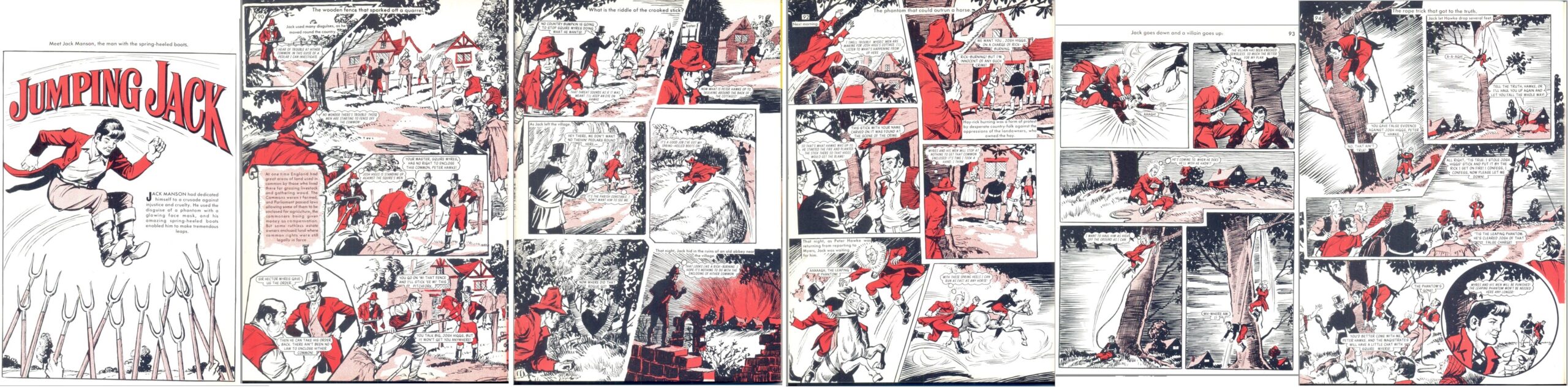
‘Jumping Jack’ Manson vs. land-grabbing Squire Myers (1970) Anti-enclosure comic strip for junior school children to teenagers

Jumping Jack Manson comes across a land-grabbing squire…
…who gets his minions to burn hay-ricks and blame it on the plucky peasants…
…but wicked Myers’ didn’t plan on Jumping Jack and his amazing spring-heeled boots!

Taken from comic The Hotspur (1970) this six-page strip is available below as single image files 3×2 or 6×1 and as a printable PDF [right click or touch and hold to download]

7MB PDF – ‘Jumping Jack’ Manson vs. land-grabbing Squire Myers (1970)

Jumping Jack Manson enclosures (1970).pdf

2MB 3×2 JPG – ‘Jumping Jack’ Manson vs. land-grabbing Squire Myers (1970)

2MB 6×1 JPG – ‘Jumping Jack’ Manson vs. land-grabbing Squire Myers (1970)


Hull City Council allow “right to grow” on unused council land [Source: The Guardian]

Hull City Council’s ‘right to grow’ motion on unused council land is a UK first

Taken from The Guardian:
Hull set to allow ‘right to grow’ on unused council land in UK first
City councillors pass motion to let community groups, charities and neighbours cultivate fruit and veg
by Patrick Barkham, The Guardian
Monday 16th October 2023
Ref: https://www.theguardian.com/uk-news/2023/oct/16/hull-allow-right-to-grow-unused-council-land-uk-first
Hull is set to become the first city in Britain to give people a “right to grow” on unused council land. Community groups, charities and even small groups of neighbours would be able to cultivate fruit and vegetables on suitable council land in what campaigners say will provide healthy local food, boost mental health and revive neglected spaces. Hull councillors unanimously passed the “right to grow” motion that means the council will produce a map of suitable land it owns and help those who want to grow food on it overcome practical obstacles such as insurance or provision of water for the plants. The motion, which will first go before the council scrutiny committee, follows a burgeoning local and national campaign for a “right to grow” on neglected urban land.

The waiting list for allotments in England has risen by 81% over the past 12 years as more than 150,000 people seek a place to grow fresh food.

“It will benefit Hull in many ways,” said Gill Kennett, a local councillor who backed the motion, which received cross-party support. “We are a deprived city and we do need cheap food. In terms of mental health benefits, growing food gives people something to do, it gives them confidence, it ticks so many boxes.”

Incredible Edible, a grassroots network of more than 150 community growing groups, is calling for a national “right to grow” law obliging all local authorities to keep a register of land that could be used for growing, and which people could apply to.

Campaigners say councils can meet the growing demand for places to grow in urban areas by stripping away bureaucratic obstacles such as growers requiring public liability insurance, which could be provided under councils’ existing insurance. Even land earmarked for development that sometimes lies unused for years could be cultivated for one or two harvests.

Pru Elliott of Incredible Edible said: “We need to see a change of rules and a change in the way land is used. If communities are given a right to grow they will use it. We just need to get rid of the red tape. If Hull can bring this to life I hope it will be an example for councils around the country that it’s something really tangible that they can run with. It’s about letting go of control a bit and trusting communities.

“It’s producing healthy food, it’s benefiting mental health, it’s reducing crime and antisocial behaviour – we’re seeing that councillors in more deprived areas get it. They recognise all these extra benefits that come with something as simple as people growing food in the local community.”

The Create Streets thinktank, whose chair is an adviser to the levelling up secretary, Michael Gove, recently produced a report calling for a “right to grow” as part of a greening up of British cities.

In Hull, the motion came about after Hull Food Partnership – a collaboration between local people, businesses, charities and the council – devised “food hustings” at the local elections, where councillors discussed how Hull could address local food issues from food banks to “food deserts”. Anna Route of Hull Food Partnership said: “Everyone should have the ability to access good quality locally produced food regardless of their background or income, and we want to remove as many barriers to feeding people well as possible.”

Darren Squires of Rooted in Hull, a social enterprise that grows food on former industrial land in Hull, said the benefits of growing food in urban spaces included providing fresh, healthy produce for food banks, boosting mental health, growing low-carbon food, and also providing wildlife-friendly green corridors in the city.

“People do want to grow but we don’t have the opportunity to unlock that land normally,” he said.

Squires said he hoped the motion would result in the council providing groups with public liability insurance under its own umbrella as well as practical help such as connecting up growers with sources of water for dry spells, whether harvested from nearby roofs or via mains pipes.

“I grow in a small yard and I can eat salad all summer and it costs me a few pounds rather than a few pounds every couple of days from the supermarket,” he added.

“There are some veg that no amount of money will get you the same quality as something you get when you pick and eat it the same day. You’ve not eaten French beans until you’ve eaten some you’ve grown.”

Empty mansions in abandoned HS2 ghost village ‘taken over by squatters, dealers and religious cults’

Empty mansions in abandoned HS2 ghost village ‘taken over by squatters, dealers and religious cults’

https://www.coventrytelegraph.net/news/local-news/empty-mansions-abandoned-hs2-ghost-27872186

Empty mansions in abandoned HS2 ghost village ‘taken over by squatters, dealers and religious cults’

The homes in Whitmore Heath were purchased by the government for the line that will now never be built

A HS2 ghost village in the West Midlands is full of abandoned mansions that locals say have been taken over by squatters. Whitmore Heath’s beautiful and pricey homes once made it a thriving community – but now squatters, drug dealers and even religious cults have allegedly moved in.

HS2 purchased 35 properties in the rural hamlet. The average property price was £600,000, but houses were compulsorily purchased by the government because the train line was set to pass under several multi million-pound mansions in the area.

Now that plan is in tatters – even though other parts of the line are still being built, some near Coventry, amid much local anger. PM Rishi Sunak announced at the Tory Party conference that the West Midlands to Manchester line would be scrapped.

Yet because people have moved out, remaining residents say the the empty homes are now trouble-spots with squatters living in the houses.

Edward Cavenagh-Mainwairing, 61, is the 33rd generation of his family to live in the Staffordshire village. He said three properties are now used as cannabis farms – and warned there is no longer a sense of community in the area.

Mr Cavenagh-Mainwairing said: “When you walk around the area, it’s a bit sad to see it all locked up and three houses are now used for cannabis. There was a sense of community, but now there isn’t.

“HS2 has strengthened us all together in a way – because we are all suffering from it. But hearing the news about it being scrapped made me feel numb, it’s still not a victory because it’s confirmation that it was a really bad decision.

“It should have been stopped earlier. A lot of people’s lives should have not been upset to the degree they have been.”

One security guard, who asked not to be named, said they had been hired to guard the home as squatters have previously lived there. They said they had even seen cults ‘trying to break in’ to the house.

What’s more, they said a religious group had even tried to arrest security guards. They said: “We’ve had cults trying to break in.

“They would even try and arrest you.” However, some residents actually like living in the village – and they are confident more people will return to the area.

Chris Shemilt, 65, moved there around five years ago with his wife, although he is in the process of moving away. Yet he has said he ‘doesn’t see anything wrong’ with the area.

He believes the homes bought by the government will go back on the market. Chris said: “I don’t see anything wrong with it myself.

“I think people will move back to the area, I think a lot of them were bought by the government – who bribed people to sell them.

“I suspect they will go back on the market.” Chris said the costs of HS2 were ‘way too high’ for it to have ever been completed as planned.

The financial advisor said: “As far as I’m concerned, the costs were way too high for them to do it. Quite simply – all they’ve got to do is run the train to Birmingham on the same line they’ve already got – which is quite a good line anyway.

“If they slightly improve that line, then they can go straight through to Manchester.”

Rishi Sunak has defended scrapping the Birmingham to Manchester line. He said: “We’re going to take every penny of that £36 billion and we’re going to spend it on transport across the country – on bus, on road, on rail, on all the forms of transport that you use every day.

“We’re going to deliver it far quicker so that you can see the benefits faster. We’re going to see it across more parts of our country.

“I think that is the right thing to do for the long term.”

Great Lives: Ken Loach on Digger, Gerrard Winstanley – BBCR4 – 26 Sep 2023

Great Lives: Ken Loach on Gerrard Winstanley – BBCR4 – 26 Sep 2023

But sadly not a lot on Pride’s Purge, or the injustice and horrors of Charles’ execution, which drove Winstanley to act, and cleared a way for the mercantile classes’ British Empire…

https://www.bbc.co.uk/sounds/play/m001qtc5
Veteran British film director Ken Loach nominates the 17th century radical pamphleteer and and leader of the Diggers, Gerrard Winstanley.

Born in Wigan in 1609, Winstanley began writing religious pamphlets after his cloth selling business in London went bankrupt and he was forced to move to the country. There his ‘heart was filled with sweet thoughts … that the earth shall be made a common treasury of livelihood to all mankind’, for ‘the great Creator Reason, made the Earth to be a Common Treasury… for Man had Domination given to him, over the Beasts, Birds and Fishes; but not one word was spoken in the beginning, that one branch of mankind should rule over another.”

Winstanley began to dig a nearby wasteland, calling on others – rich and poor -to join him in the digging, which he believed would start a revolution and feed the poor. His ideas were radical, communal, spiritual and deeply challenging. Within a year the Diggers had been aggressively expelled from their site of occupation.

The late Tony Benn called the Diggers, ‘the first true socialists’, but Winstanley has also been claimed by anarchists and environmentalists.

With Emeritus Professor of Early Modern history, Ann Hughes. Presented by Matthew Parris and produced for BBC Audio in Bristol by Ellie Richold

The Land Is Ours’ 1999 occupation of St George’s Hill

Winstanley (1975) dir. Kevin Brownlow

WATCH HERE ON ARCHIVE.ORG

Or buy via the BFI – Winstanley – A powerful story of the 1649 St George’s Hill commune inspired by the visionary leadership of Gerrard Winstanley. 1649. With poverty and unrest sweeping England, a group of impoverished men and women, known as the diggers, form a settlement on St George’s Hill, Surrey. Inspired by the visionary leadership of Gerrard Winstanley, the commune’s tireless, yet peaceful attempts to assert their right to cultivate and share the wealth of the common land, are met with crushing hostility from local landowners and government troops. With Winstanley, filmmakers Brownlow and Mollo (the creators of It happened Here) have produced an astonishingly authentic historical film, and a powerful, moving story of one extraordinary man’s vision. Special features New restoration by the BFI National Archive. New filmed interview with Kevin Brownlow and Andrew Mollo (38 minutes) It happened Here Again (Eric Mival, 1976, 48 minutes) ­ the making of Winstanley 9 Dalmuir West (Kevin Brownlow, 1962, 12 minutes) Fully Illustrated 32-page booklet with contributions by Marina Lewycka (author of A Short History of tractors in Ukrainian), Eric Mival, Jonathan Rosenbaum, Tom Milne, and David Robinson; plus biographies and credits. Dolby Digital 2.0 (320kbps)

Winstanley is a 1975 British black-and-white film made by Kevin Brownlow and Andrew Mollo and based on the 1961 David Caute novel Comrade Jacob.

The film details the story of the 17th-century social reformer and writer Gerrard Winstanley, who, along with a small band of followers known as the Diggers, tried to establish a self-sufficient farming community on common land at St George’s Hill (now a private gated estate, the ‘Beverly Hills’ of Britain) near Cobham, Surrey.

The community was one of the world’s first small-scale experiments in socialism or communism, and its ideas were copied elsewhere in England during the time of the Protectorate of Oliver Cromwell, but it was quickly suppressed, and in the end left only a legacy of pamphlets and ideas to inspire later generations of socialist theorists.

Ramblers unite at Scots Dyke, near Richmond, North Yorkshire, to protest against England’s draconian right to roam laws

Ramblers unite at Scots Dyke to protest against England’s draconian right to roam laws

https://www.theguardian.com/world/2023/sep/23/ramblers-unite-at-scots-dyke-to-protest-against-englands-draconian-right-to-roam-laws

English and Scottish walkers meet in mass trespass to call for greater public access to land in England and Wales, like the more generous laws of Scotland

Flag-waving activists for land reform have expressed their demands for greater freedom to roam in England and Wales by staging a symbolic trespass through farmland on the Scottish border.

In a bid to highlight Scotland’s far more generous rights of access to the countryside, around 40 campaigners tramped through boggy, dense woodland to arrive at an earth dyke north of Carlisle which once marked the medieval border.

They lined up on the Scots Dyke, built in 1552 to fix the English-Scottish border in a largely lawless district then known as the Debatable Lands, where Jon Moses, an organiser of the Borderlands rally, stood on the bank with one leg in England and the other in Scotland.

“My left leg is lawful; my right is unlawful,” he said, referring to the substantial differences in right-to-roam laws on either side of the border. That message was echoed by the activists, who sang and danced to an ironic version of the hokey cokey in a static congo line along the dyke.

They were met at the dyke by Scottish activists, including Andy Wightman, a land reform expert and former Scottish Greens MSP, and Dave Morris, former chief executive of Ramblers Scotland. They had legally walked there across land north of the border owned by the Duke of Buccleuch. The southern contingent had technically trespassed over a farm track and private woodland to arrive at the dyke, before staging a ceremony in a Scottish field which was symbolically doused with Newcastle Brown Ale and Scotch whisky.

The Borderlands event was arranged by the Right to Roam campaign, bidding to replicate Scotland’s statutory freedom to walk, row or swim across the vast majority of open land, farm fields, woods and waterways in England and Wales.

Scotland’s longstanding traditions of free access, subject to restrictions to protect private gardens and work such as forestry, were enshrined in law by the Land Reform (Scotland) Act 2003; the protest at Scots Dyke was intended to mark the act’s 20th anniversary.

In England and Wales, the Countryside and Rights of Way Act 2000 is far more restrictive. It provides “strikingly limited” rights which are also starkly unequal, argues the Right to Roam campaign.

The act allows free access to only 8% of England and Wales, chiefly along defined paths or designated open land such as national parks. But that leads to hugely unequal levels of access for people to their local areas. While 72% of the Peak District has open access, that falls to 0.6% in Kent.

Recent analysis by the New Economics Foundation and the Ramblers shows deep social inequalities regarding access to designated rights of way in England and Wales; people in the richest areas have 80% more paths, and in the whitest areas have 144% more.

The England and Wales act also prevents free access to around 97% of England and Wales’ lakes and rivers, unlike Scotland’s legislation, which allows kayakers, swimmers and rowers the statutory right to use nearly all open water.

The Right to Roam campaign is pinning its hopes on Labour following through on its recent pledges to replicate Scotland’s access laws for England and Wales if it wins power at the next election.

Nadia Shaikh, a Right to Roam organiser, told the protesters the Scottish legislation allowed English activists “to remind ourselves this is absolutely possible; it is absolutely achievable”.

Divisions

But there are splits in the English access movement: the Ramblers group believes the English act can be enhanced to include access to watersides (but not on to the water), to woodlands and some downlands. England’s very large number of rights of way makes Scotland’s model unsuitable and unnecessary, and would undermine the “trust and consensus” built with landowners, they argue.

In a brief ceremony at the Scots Dyke, Wightman handed over a mocked-up land reform bill for England and Wales – modelled heavily on Scotland’s legislation – to 11-year-old Shafag Elnour, the daughter of Sudanese refugees now living in Newcastle.

“I just think that we should have a right to roam,” said Elnour, carrying a small green banner she had made with the slogan “right 2 roam” in her hands.

“It is just stupid that all those people buy lots and lots of land and do nothing with it.”

Her father, Mohaned Ahmed, a human rights lawyer and consultant present at the event with Elnour’s two brothers and mother, said being a black refugee added additional barriers to enjoying the English countryside.

“I think it is inhuman that land is for a handful of people, not for everyone,” he said.

Indigenous people in Brazil shed tears of joy as the Supreme Court enshrines their land rights in win for president Lula

In several former European colonies, such as Vancouver and Australia, rights to freely inhabit and work reservation lands, formerly under private ownership or otherwise threatened, are being returned to indigenous people

RIO DE JANEIRO (AP) — Indigenous people celebrated Thursday after Brazil’s Supreme Court ruled to enshrine their land rights, removing the imminent threat those protections could be rolled back.

https://www.msn.com/en-us/news/world/tears-of-joy-after-brazils-supreme-court-makes-milestone-ruling-on-indigenous-lands/ar-AA1h4Prn

The justices had been evaluating a lawsuit brought by Santa Catarina state, backed by farmers, seeking to block an Indigenous group from expanding the size of its territorial claim. Nearly all of the high court’s justices voted to support the Indigenous group, which has far-reaching implications for territories nationwide.

Dozens of Indigenous people in traditional yellow feather headdresses and body paint danced, sang and jumped around in front of a multitude of flashing cameras in the capital of Brasilia after the decisive vote was cast. Some wiped away tears of joy.

“I’m shaking. It took a while, but we did it. It’s a very beautiful and strong feeling. Our ancestors are present — no doubt about it,” said Jéssica Nghe Mum Priprá, who is from the Xokleng-Laklano Indigenous group.

In the case before the court, Santa Catarina state argued a legal theory being pushed by opponents of further land allocations for Indigenous groups. It said that the date Brazil’s Constitution was promulgated — Oct. 5, 1988 — should be the deadline for when Indigenous peoples to have already either physically occupied land or be legally fighting to reoccupy territory. They also claimed it would provide legal certainty for landholders.

Nine of the court’s 11 justices rejected that argument.

“Areas occupied by Indigenous people and areas that are linked to the ancestry and tradition of Indigenous peoples have constitutional protection, even if they are not demarcated,” said Justice Luiz Fux, who cast the vote that established the majority.

The two justices who voted to support Santa Catarina’s position were appointed by the President Jair Bolsonaro, who was a vocal opponent of expanding Indigenous territories and supported their assimilation.

Indigenous rights groups argued the concept of the deadline was unfair, saying it does not account for expulsions and forced displacements of Indigenous populations, particularly during Brazil’s two-decade military dictatorship.

The lawsuit put at risk the status of Brazil’s hundreds of Indigenous territories, said rights group Articulation of Indigenous Peoples of Brazil, known by the Portuguese acronym Apib.

Large groups of Indigenous men and women from different states and ethnicities had gathered in and around Brasilia in recent months during the high court’s deliberations.

Francisco Cali Tzay, the U.N. special investigator on the rights of Indigenous peoples, had urged Brazil’s Supreme Court to protect Indigenous lands.

“Under the constitution, Indigenous peoples are entitled to the permanent possession of the lands they traditionally occupy,” Tzay said in a 2021 statement.

He said a ruling in favor of business interests “could legitimize violence against Indigenous peoples and inflame conflicts in the Amazon rainforest and other areas.”

Though the case involved only one Indigenous group, the Supreme Court gave it “general repercussion” status, meaning the ruling will serve as a precedent for all instances of justice involving Indigenous groups.

It thus applies to hundreds of administrative procedures and legislative initiatives that are in progress and is likely to torpedo a proposal in Congress to enact the same 1988 deadline.

However, that legislation also carries other threats to Indigenous rights, potentially opening the door to an easing of restrictions on mining, dam construction, agricultural and transportation projects in Indigenous lands.

“We’ve won the battle, but not the war,” Dinamam Tuxá, executive coordinator of Apib, said in Brasilia. “We will continue to fight for Indigenous territories to be demarcated, so that the rights of indigenous peoples are safeguarded and protected.”

Since taking office in January, President Luiz Inácio Lula da Silva has given significantly more attention to the demands of Indigenous peoples than his predecessor, Bolsonaro.

He created the country’s first Ministry of Indigenous Peoples, headed by Indigenous woman Sonia Guajajara, and demarcated eight new Indigenous territories.

Indigenous territories cover nearly 14% of Brazil’s vast expanse, according to data from the Instituto Socioambiental. The process to officially establish an Indigenous territory can take decades.

MST Founder João Pedro Stedile Confronts Landlords in Brazil’s Congress

MST Founder João Pedro Stedile Faces Off against Right Wing in Congress

Posted by Internationalist 360° on August 17, 2023

João Pedro Stedile of the National Board of the MST testifies in the CPI on the MST

The leader was summoned by right-wing deputies to testify before the Parliamentary Commission of Inquiry that is “investigating” the Landless Rural Workers’ Movement

After seven hours of questioning before the Parliamentary Commission of Inquiry (CPI) “investigating” the Landless Rural Workers’ Movement (MST), João Pedro Stedile exited the Chamber of Deputies and was embraced by dozens of representatives of people’s movements, religious leaders, and parliamentarians who sang “This struggle is ours, this struggle is of the people. And only in struggle, will we create a new Brazil.”

Stedile was summoned to testify to the CPI by the right-wing deputies Ricardo Salles, the minister of the environment under Jair Bolsonaro, and Zucco, a member of the Brazilian military. The establishment of the CPI was approved on April 26 by the Chamber of Deputies of the National Congress, dominated by the right, in order to “investigate” “the activities,” “the real purpose,” and “the means of funding” of the MST.

The CPI had its first session on May 23 and since then they have received testimonies from diverse “witnesses” and experts who are questioned by the deputies in the commission. The information collected throughout these months is then drafted into a report which is presented to different entities of the judicial, executive, and legislative branches of power with conclusions and recommendations.

However, analysts have pointed out that the “investigative” commission has largely focused on bringing former or disgruntled members of the two million person movement to testify about grievances they have with local leadership, alleged irregularities or even alleged crimes which they participated in or witnessed, and other isolated incidents. Right-wing deputies which until recently composed the majority of the commission, have also used the space to launch baseless sweeping accusations at the movement and criticize its struggle not only for popular agrarian reform but for social change, against racism, and for a sovereign Brazil where all can live with dignity.

Many have also pointed out that it is no coincidence that this CPI is occurring alongside moments of great political difficulty for the country’s right-wing including an ongoing CPI investigating the coup actions committed on January 8 in Brasilia by thousands of Bolsonaro supporters with links to government officials and businessmen, as well as the investigation of several members of the Bolsonaro government as well as some of his close allies over corruption.

So, what has come to be known popularly as the “CPI Circus against the MST” had one of its last major days of work on August 15 with the testimony from João Pedro Stedile, one of the founding members of the MST and a member of the national board. Despite their efforts to catch the leader off guard and tire him out through hours of questioning and accusations, the testimony of Stedile ranged from explanations of Marxism, a defense of the organizational structure and vision of the MST, and a deep criticism not only of capitalism and agribusiness, but also of how the deputies carried out the work of the commission.

Methodological errors

The deputies running the CPI have employed a common tactic used by the right, which is to use testimonies of specific individuals who have been sought out and previously identified as against the MST, to support their claims about the movement. This move was sharply criticized by João Pedro in his testimony.

He said that in order for the CPI to have results found more faithful to reality, it should have taken a random sample of people that live on MST settlements and encampments, and not pick certain groups in advance.

“I want to make a statistical observation. We have 500,000 settled families and 60,000 encamped families, according to INCRA [National Institute for Colonization and Agrarian Reform]. If you take a random sample of 1%, that would be 5,000 families you would have to listen to, although the most serious evidence is of even higher percentages.”

After Deputy Salles, asked his opinion about cases where people allegedly try to personally benefit from the MST’s projects on settlements and encampments, the landless leader responded by referencing the German sociologist Karl Marx: “In a capitalist society, all classes, whether the bourgeoisie, the petty bourgeoisie, the working class, the peasantry, the workers in general, have a lumpen fraction. What is a lumpen? It’s that opportunist who wants to live off the work of others, who wants to exploit the work of others. So these lumpens exist throughout society. You’ll find them among the bourgeoisie – drug traffickers, for example, are billionaires and are lumpens – in the middle class, among liberal professionals, among lawyers, journalists, MPs, among workers and among peasants.”

Can the right understand movement organizing?

Another major line of questioning lodged at the landless leader was regarding the work that often takes place in the collective areas of the MST. The right-wing deputies, seemingly unable to understand why people would willingly organize collectively and distribute work to advance the common good, attempted to accuse MST leaders of authoritarianism and imposing forced labor on members.

In response, Stedile highlighted the characteristics that mark the movement’s form of organization, citing aspects such as the collective awareness, the use of a decision-making process that is always collective rather than individual, the division of tasks, discipline, and the educational and intellectual training of the militants that join the movement on their own volition.

When he mentioned the organization’s characteristics, the economist sent a message to Kim Kataguiri from the União Party and one of the founders of the Free Brazil Movement (MBL) who is part of the CPI. The organization has produced different conservative and extremist youth leaders since its creation nine years ago.

“Among the organizational principles, everything has to be collective. Everything has to be in the form of a committee because it is the collective that protects [us] from the opportunism of false leaders. Don’t adopt this terminology of ‘president’, ‘treasurer’, ‘secretary’. The organizing principles are universal. They apply to the workers’ movement and they apply to Kim’s movement. I hope he’s taking notes. Any popular social movement has to adopt these principles,” Stedile explained in what many have deemed a master class on popular organization, provoking laughter from the audience.


Education for all: another conquest of the MST

While explaining the actual work and functioning of the MST, João Pedro also emphasized the centrality of study and education in the MST. Whether its carrying out literacy campaigns with adults and young people for people in MST and in communities they work with, developing popular pedagogy for the childcare and primary schools organized within the MST settlements and encampments, or fighting for policies that facilitate access to higher education for the landless, education for all is more than a slogan.

During the CPI, João Pedro highlighted that, as a result of this historic effort, around 250 landless workers have already studied law in the university. He also highlighted the importance of the National Program for Education in Agrarian Reform (PRONERA) created in 1998 during the Fernando Henrique Cardoso government (1994-1994), as a result of pressure from union and social struggles. Stedile described PRONERA as a “fantastic achievement” for the movement.

“I brought here the proof of the ‘crime’ – that’s how you use [the word], right? Ney [Strozake], the comrades who are here, are all lawyers who are children of [land reform] beneficiaries. Can you believe that? If it hadn’t been for PRONERA, they’d be [working the land] or they’d have become lumpens,” Stedile joked, pointing to the group of MST lawyers accompanying him at the session. The mention was also made in front of a silent plenary and a visibly embarrassed Ricardo Salles: Ney Strozake, one of the MST’s legal advisors, is also the lawyer of the former Environment Minister in some cases.

Agribusiness

During the hours-long testimony, the economist heavily criticized the more conservative agribusiness. At one point during his answers to the CPI deputies, the leader pointed out that this segment of the rural sector is currently experiencing divisions in response to the PT administration. Part of the sector is active in the Lula government, as is the case of the Minister of Agriculture, cattle rancher Carlos Fávaro, who is a senator-elect for Mato Grosso and is currently on leave from his mandate.

“Agribusiness is divided. The half that has any sense supported Lula. The other half is Aprosoja [Brazilian Association of Soybean Producers, one of the sector’s political arms], which only thinks about making money. Part of agribusiness is already aware of the limits and is already migrating to another form of agriculture, what is now known as ‘regenerative practices’, to replace pesticides with agroecological pesticides. Part of agribusiness is still going to heaven,” Stedile joked. “But the dumb agribusiness, which only thinks about easy profits, has its days numbered,” he added.

Occupation vs. invasion

The key political disputes between the Bolsonaristas and MST supporters were present throughout the landless leader’s CPI testimony. At one point during the hearing, deputy Rodolfo Nogueira from Bolsonaro’s Liberal Party, questioned Stedile about whether the leader “believes he has a license of impunity” for allegedly “inciting crimes” in the country. “I have never incited any crime,” replied the economist, to which he was interrupted by the deputy, who said that “land invasion is a crime.”

Stedile took the opportunity to highlight the difference between “occupation” and “invasion”, the latter being an expression often used in public debate by more conservative politicians to create confusion on the subject. “Land invasion is a crime, like the farmers in Mato Grosso do Sul invading indigenous land. What the MST is doing is occupying land as a way of putting pressure so that the Constitution is implemented. Invasion of land or any public property is when someone does it for their own benefit, and then it is characterized as squatting and is criminalized by the Penal Code,” said Stedile.

The MST leader continued his reasoning by highlighting the legal aspects surrounding the issue: “What our movement is doing, recognized by jurisprudence, is not an invasion. It is occupation, and occupation here is not squatting, so much so that, to your despair, of the many occupations that have taken place over the last 40 years throughout Brazil, no one has been arrested or convicted.” “If you want to end the occupations, expropriate large unproductive properties, because then there’s land for everyone,” he added.

In another moment, the deputies asked about Stedile’s participation in the entourage that accompanied President Lula to China in April this year. Deputy Salles asked him if there was “any movement in China analogous to the MST in Brazil”. “No, because in 1949 they carried out land reform. [For] those of you who want to defeat the MST so badly, the formula is simple: carry out agrarian reform and the next day the MST will disappear,” he said.

Solidarity

Half an hour before the start of the hearing, João Pedro Stedile’s arrival at the Chamber drew the attention of everyone nearby. The landless leader was welcomed by dozens of people who had gathered there to show solidarity. Federal deputies, religious leaders, trade unionists, and members of different popular movements crowded around and chanted slogans and songs about agrarian reform as a way of embracing Stedile with words of support. From there, he made his way to the room, accompanied by a procession. “We are here in the name of the model of society that we seek to give our support to those who help organize the people in Brazil,” said Pastor Luís Sabanay.

“What drives me to be here is that I want the land for those who plant on it. I want nature alive because we don’t eat dead nature. And what moves me to be here is that, as well as not letting go of anyone’s hand, is that it is [important] to be together at a time like this. It is to say that the MST moves us because it teaches us what my religion already brings in its daily life, which is [the idea that] we need nature because without it there is no orixá,” said Makota Celinha, general coordinator of the National Center for Afro-Brazilian Africanity and Resistance (Cenarab), who received a public greeting from Stedile at the start of the session.

Members of parliament who are not part of the CPI also joined the procession to embrace Stedile and wish him strength. “The MST is a movement that we all cherish, which fights for the democratization of the land, demonstrates to the Brazilian people that it is necessary to fight the ultra-right, defend democracy, and share wealth. It’s a movement that lives in our hearts, that’s why I came here, on his behalf, to congratulate the entire MST,” said Congressman Rogério Correia of the Workers’ Party (PT).

Politicians from other levels of government also attended the event with the same objective. This was the case of Pernambuco state deputy Rosa Amorim of the PT, who is the daughter of founders of the MST in several states and grew up on an agrarian reform settlement. “We have an elected agrarian reform caucus in several states of the country and, at this very important moment, which is also a battle in the institutional realm, we have to be here to show our solidarity. Today we are going to send a message to Brazil about what the MST does and produces,” she said.

One sighting that attracted the spotlight was that of the governor of Ceará, Elmano de Freitas of the PT. Having come to Brasilia to fulfill agendas in some ministries, he went to the Chamber of Deputies to greet Stedile at the CPI and stayed for a couple of minutes. Speaking to Brasil de Fato, Elmano highlighted the movement’s work in the countryside of Ceará.

“In Ceará, we are closely acquainted with the landless movement, which has built an agro-industry in the milk production chain in the Quixeramobim region, which has developed agro-industries in the area of [production with] goats and sheep, in the area of honey, generating opportunities for thousands of families who used to live in extreme poverty and today live with dignity, have children going to college, going to school full time. Therefore, the landless in Ceará, as it is throughout the country, represent an organization of the most humble people to be able to live with dignity,” said the governor.

Various parliamentarians from the progressive camp wore MST hats during the CPI meeting as a way of paying tribute to Stedile and the organization. “I wear it with great pride and as a way of recognizing the struggle for agrarian reform in Brazil,” said Fernanda Melchionna, deputy from the Socialism and Liberty Party (PSOL). Congressman Nilto Tatto of PT also joined the group. “Wearing the MST hat at the CPI that wants to criminalize the movement is an act of resistance, solidarity and gratitude for everything the organization has done for the Brazilian people,” he said.

MST evaluates CPI

Ayala Ferreira, one of the leaders of the MST’s Human Rights Sector, said following the hearing that Stedile had demonstrated his superiority in terms of political capacity and knowledge of the subject.

“Our evaluation is that he gave a lesson, which we already imagined would happen. He didn’t come here to convince the agro-military, Bolsonaro sectors of the importance of agrarian reform and the relevance of the MST in this agenda. He came to talk to Brazilian society, to all the people who followed [the testimony] online, on the pages that published [the testimony], to see everything we’ve been saying: that the MST is going to celebrate 40 years of history and struggle for the democratization of the land, highlighting the need for agrarian reform,” said Ayala.

In a public statement sent to the press shortly after the committee’s session, the national leadership of the MST expressed a positive assessment of João Pedro Stedile’s participation in the committee, but also criticized the CPI’s handling of the work. “This CPI has been running for three months, under the command of Bolsonaro parliamentarians, in an attempt to criminalize the MST and prevent the resumption of the National Agrarian Reform Policy, as well as trying to wear down the federal government. However, the baseness and lack of legitimacy and seriousness of the Bolsonaro deputies is leading it to be closed earlier than expected by these parliamentarians themselves,” the text says.

With reports from Brasil de Fato.