Category Archives: Posted

My Home Is A Shed: Cornwall author, songwriter and housing campaigner Catrina Davies

Cornwall’s housing crisis laid bare by woman who lives in a shed

Catrina Davies lives an alternative lifestyle because she feels there’s no alternative – By Jacqui Merrington 07 JUL 2019

https://www.cornwalllive.com/news/cornwall-news/cornwalls-housing-crisis-laid-bare-3065726

Catrina Davies has spent the past six years living in a shed in west Cornwall.
Desperate to return to the place where she grew up but unable to afford a place of her own, she moved into an old shed that was once her dad’s office.
The ramshackle corrugated iron building was full of holes, rats and spiders, but she moved in, just to be back home. She thought it was a temporary solution.
Six years later she’s still there, not because she is desperate for an ‘alternative’ lifestyle – more that she feels there is no alternative. The housing crisis has left her with nothing but a shed for a home.
Catrina, 40, said: “I was living in a shared house in Bristol and I kind of ran away back to the shed which used to be my dad’s office in the 90s. I camped in it. It was supposed to be temporary but then I realised there was very little option for me.
“I really wanted to be here because it feels like home. I am lucky because I had access to this shed.”
An author and musician, Catrina works cleaning and gardening for people around west Cornwall, earning enough money to live, make music and write from her tiny corrugated home, surrounded by books.
She feels that while the housing crisis is a global problem, caused by capitalism and consumerism, it’s a particular issue in Cornwall where second homes price local people out of the market.
“Cornwall is very interesting because it has got this dual economy, this veneer of wealth and yet the actual economy of Cornwall is very deprived.
“For a lot of people growing up here it is hard to leave because you do fall in love with the landscape.
“Thirty years ago you could buy a small flat in Cornwall for £20,000 but now it would cost £200,000 and wages have not changed very much at all. I’m paid a bit more but nowhere near enough.
“It is beginning to polarise people because the life you can expect to live is very different depending on whether you bought a house 20 years ago or you didn’t.”
Over three quarters of neighbourhoods in Cornwall are more deprived than the national average, according to recent statistics. The county is actually among the 50 poorest regions in the whole of Europe.
Catrina says housing has become a commodity – hence the rise in second home ownership in Cornwall – and she believes the same drive to own homes and second homes is contributing to the global crisis around climate change too.
She has just written a book, Homesick: Why I Live In A Shed, which explores her own journey to Cornwall, her struggle to make it as a musician and writer and the alternative lifestyle she’s created here.
In it, she sets her own story within the context of all those struggling to afford a home – local families living in tents every summer to rent out their homes to tourists to help them pay the mortgage or teachers leaving Cornwall because they can’t afford a home.
“I wanted to write something that is not about a utilitarian view of the housing crisis – of people in boxes – but that explored the human side of housing, which is about a relationship with a place and the things that housing offer that is not practical, but emotional. It is about having shelter and autonomy and security.”
While the shed gives Catrina somewhere to live in the place she calls home, it’s a precarious lifestyle and the uncertainty over her future in her tiny space has been a “huge source of anxiety” for her.
She has applied for a lawful development certificate from Cornwall Council to enable her to continue living there in the future.
“Mustering up the courage to do this application took years,” she said. “When I realised the book was going to be published it dawned on me that I was going to be drawing attention to myself and I had to get that application in. I hope very much that it will be OK.”

Cassington village Allotments in Oxfordshire under threat by Blenheim Estates

Dear TLIO,

I was very interested to read that your Organization campaigns peacefully for everyone to have access to the land, its resources, and the decision-making processes affecting them.

My wife and I have been sustainably growing our own food at the Cassington village Allotments in Oxfordshire. The allotments have been in use by local people for over 100 years. They are fully occupied by over 30 plot holders and there is a waiting list.

The site is also a haven for wildlife with its ponds, meadows and many trees. Including some rare and protected species.

Now Blenheim Estates wants to demolish and cover the allotments in concrete to build rental homes. They already own all the land around the village, mostly monoculture farming fields, and 12,000 acres in total.

If you are interested in helping us there is a petition created by our Allotment Association to be sent to the local council asking for our site to be preserved and building permission declined.
Feel free to share it with those you think would want to support us.

https://www.change.org/p/save-cassington-allotments

More information can be found at:
https://www.thetimes.co.uk/article/gardeners-dig-in-to-battle-blenheim-estate-homes-m6gtf6zhg

You are welcome to visit our Allotments and see for your self the beautiful gardens and wildlife in them.

Please contact me on s.g.serra@hotmail.com

Best regards
Samuel Serra

Gender Identity Politics: Land Justice Network Trans Activists Ban People Who Don’t Share Their Views

Radical Intransigence

Gender Identity Politics: Trans Activists Exclude Land Justice Network Campaigners Who Don’t Share Their Views
https://thelandmagazine.org.uk/articles/radical-intransigence-0
download
as pdf

Mike Hannis finds a much-needed debate being shut down.

Last summer we published a short report on the Land Camp organised by the Land Justice Network (Issue 25, p51). We took a humorous angle, but were clearly supportive of LJN, their anti-grousemoor campaign, and the broader objectives of the camp. Raising awareness of how inequitable ownership patterns make unsustainable land uses more likely is after all what The Land is all about.

It may seem odd to go back to that event now, but a separate story emerged from it which also needs to be covered. For many, this story and its ramifications entirely overshadowed the intended message of the camp. This was particularly true for one person present – a woman whose activist credentials might be said to be second to none, yet who was told in no uncertain terms that she was not welcome.

So why would young activists shun a woman who has been fighting hard for causes they espouse since before many of them were born? Answering this question requires some background. The twisting tale starts thirty years ago.

FIGHTING BURGER POWER

As a result of handing out campaign leaflets outside McDonalds, in 1990 a young woman called Helen Steel was one of five members of London Greenpeace sued for libel by the burger giant. Three apologised, but Steel and her eventual co-defendant Dave Morris chose to fight in court. The resulting ‘McLibel’ case remains the longest in English legal history, as well as perhaps its most extreme ‘David versus Goliath’ struggle.

The initial High Court trial alone involved 40,000 pages of evidence and 130 witnesses. Denied legal aid, Steel and Morris represented themselves, receiving occasional free legal assistance along the way from (among many others) Keir Starmer. McDonalds’ legal bills were estimated at over £10 million. In 1997, a High Court judge found that Steel and Morris had indeed libelled McDonald’s, and ordered them to pay the corporation £60,000. However in a PR disaster for McDonald’s, he also found that several of the claims in the leaflet were true, not least those about misleading advertising and the exploitation of children. In 1999 the Court of Appeal reduced this award to £40,000, finding that several further claims (about workers’ pay and conditions, and likely health effects of eating McDonald’s burgers) were also true.

Steel and Morris then appealed to the House of Lords, arguing that they had been unfairly denied legal aid. The Lords refused to accept the case, so they moved on to Europe. In 2005 the European Court of Human Rights finally ordered the UK government to pay Steel and Morris £57,000 in compensation, ruling that the original case had breached Article 6 (right to a fair trial) and Article 10 (right to freedom of expression) of the European Convention on Human Rights. English law, said the Court, had failed to protect the public right to criticise the activities of corporations.

TOO CLOSE TO HOME

Ironically, Steel had no part in writing the original leaflet. There was little discussion in court of who had done so, as the alleged libel consisted in its distribution. It had apparently been co-written by several members of London Greenpeace.

Many years later in 2011, it finally emerged that one of the authors of the notorious leaflet had been an undercover policeman, whose real name was Bob Lambert. Lambert was in fact one of two Special Branch spies in London Greenpeace during that period. Though married throughout with two children, he had in 1985 already fathered a child with another female activist while undercover before orchestrating the breakdown of their relationship as an exit strategy at the end of his deployment.

The other police infiltrator, John Dines, began a deceptive intimate relationship with Steel shortly before McDonalds served their libel writs. The relationship lasted almost two years and they rented a flat together, meaning Dines was able to access confidential legal advice Steel was receiving. Concerned after his abrupt departure she spent years trying to trace him, finding inconsistencies and discovering that he had been using the identity of a dead child, but confirming the full shocking truth only in 2010 (and securing official confirmation only in 2016). Alongside seven other women also tricked into relationships with undercover police officers, she then took the Metropolitan Police to court, in another marathon unfunded case. In November 2015 the women won an unprecedented public apology from the police, acknowledging responsibility for serious violations of the women’s human rights.

Steel remains a key figure in ongoing campaigns seeking justice for women similarly deceived, and broader disclosure of the names and activities of the many police officers known to have infiltrated leftwing, anti-war, environmentalist and animal rights groups since 1968. Much of this activity centres on battling for transparency and fairness in the conduct of the Public Enquiry into Undercover Policing, which was grudgingly set up by Theresa May in 2015 but is not expecting to hold its first evidence hearing until summer 2020.

EQUAL RIGHTS

Steel is also involved in a number of other campaigns, one of which is the Land Justice Network. She was a founder member of the LJN action group, and also part of the wider LJN network after attending the founding ‘Land for What?’ conference in November 2016. Another focuses on the potential erosion of women’s sex-based rights by proposed changes to the 2004 Gender Recognition Act, and relatedly, protection of the right to express opinions on this issue. Curiously, it was her involvement in this latter campaign that some considered incompatible with her presence at the Land Camp.

The 2010 Equality Act (EA) lists nine ‘protected characteristics’ on the basis of which it is illegal to discriminate against people, or to harass or victimise them. One is sex: men and women must be treated as social equals. Importantly though, being treated as equals does not always mean being treated identically. The Act contains a number of exemptions and exceptions – contexts in which discrimination on grounds of sex is legitimate, usually because it is in fact required in order to ensure that one sex (usually women) are not unfairly disadvantaged or endangered.

Many instances of such legally permissible discrimination involve reserving certain spaces, services and roles only for women. This allows for instance the continued existence of women’s prisons, refuges, and toilets, and the exclusion of men from competing in women’s sport. It also ensures that certain jobs are reserved for women, and that political parties can run all-women candidate shortlists in order to address existing imbalances.

‘Man’ and ‘woman’ are understood in the Act as categories to which people belong on the basis of sex – that is, according to whether their physical bodies are male or female. So far, so apparently simple … but this is where the complexity begins.

SELF-IDENTIFICATION

‘Gender reassignment’ is also a protected characteristic under the EA, meaning that it is illegal to discriminate against a person because they are undergoing (or even ‘proposing to undergo’) a process of gender reassignment. This does not mean that, for instance, a man in the process of becoming a trans woman must be treated for the purposes of the Act as a woman. He remains legally a man, but one with the protected characteristic of gender reassignment.

If however such a person obtains a Gender Reassignment Certificate (GRC) under the 2004 Gender Recognition Act (GRA), then they do legally become their newly ‘acquired gender’. Confusingly, their GRC entitles them to a new birth certificate, on which they are shown as a new sex – in this case, female. (Birth certificates record sex, not gender.) This change is officially termed a ‘legal fiction’, because medically speaking it is not possible to actually change the sex of a human body, even with surgery and hormones. Contrary to widespread assumption, most trans people do not elect to undergo surgery, and this is not required to obtain a GRC.

A trans woman with a GRC and a new birth certificate may therefore become entitled to most of the legal protections afforded to biological women by the EA, including access to many (though not all) spaces and occupations reserved for women. For this and other reasons, a GRC becomes a desirable thing to have as a trans person. But trans rights campaigners say the process of getting a GRC is too onerous, because it requires a long wait and a specific medical diagnosis of ‘gender dysphoria’. In their view a person describing themselves as having been ‘born in the wrong body’ should be believed, rather than being told they are suffering from a psychological disorder. They therefore argue that applying for a GRC should just involve a simple process of ‘self-ID’, through which the applicant formally identifies as their new gender and thereby enshrines this as their new status for all legal and official purposes.

Following determined lobbying, the Government was in 2018 persuaded to open a consultation on reform of the GRA, including the possibility of moving to a system of self-ID. This was highly controversial, and matters escalated rapidly into acrimonious disagreement between trans rights campaigners and those who argued that self-ID effectively meant redefining the word woman, and would create or exacerbate threats to women’s rights to single sex services, facilities and roles.

This latter group – which includes Helen Steel – seek to preserve as far as possible the principle that the test for admission to reserved roles or spaces should be a person’s physical sex, not their ‘gender identity’. They argue that under a self-ID system there would be no defined criteria to determine whether a person is a woman, and hence no effective way of preserving women-only spaces (including prisons and refuges), with serious consequences for safety and privacy in such spaces. Concerns also arise regarding political and workplace representation for women, and fairness and safety in women’s sport.

INNATE GENDER?

Due in part to current political turmoil, self-ID appears to have been kicked into the long grass for now. But the highly-charged debate sparked by the GRA consultation continues.At one level the disagreement centres on whether there can be such a thing as an innate gender identity that human beings are born with, independent of both physiology and social conditioning. If there can, then it could make sense to speak of a person’s ‘true’ gender identity not matching their ‘gender assigned at birth’. A person could literally be a woman trapped in a male body, or vice versa. It would then be plausible to claim that since only I have access to my inner reality, only I can say what my true gender identity is, and that I should therefore be able to ‘self-identify’ as whatever gender I consider myself to be.

This claim that gender is innate has led to the phrase “trans women are women” being held up as an article of faith, denial of which supposedly reveals one to be ‘phobic’ about trans people, or to ‘deny their right to exist’. It is not enough to accept trans women’s right to live and self-describe as women. In order not to be accused of transphobia, everyone must sign up to the idea that trans women literally are women, and that being a woman (or a man) is a matter of gender identity, not a matter of biology. Campaigners publicly questioning this idea (some of whom adopted the dictionary definition ‘woman = adult human female’ as a slogan) are accused of bigotry.

The ‘gender-critical’ position taken by (often older) feminists like Steel is that far from being innate, ‘gender’ is no more – and no less – than a set of pernicious social constructs dictating how female and male people ‘should’ behave, which serve to impose a hierarchy of male domination and female submission. To accurately describe a person as a woman (or a man) is to identify them by sex, not by gender. Nobody has an innate gender identity, because gender is something imposed on them by society after birth. Sex on the other hand is a matter of biology, and it is not possible to change the biological maleness or femaleness of a human body.

Gender-critical (GC) feminists argue that women are structurally and personally oppressed by men, and by male-centred structures of power, not because of their felt ‘gender identity’, but because of their sex – because of physical facts about their (child-bearing and statistically smaller) female bodies. It is a person’s sex that determines which set of socially-determined gender roles gets imposed on them.

On this view, the idea that gender is innate and independent of sex reinforces sexist stereotypes of how men and women should behave, rather than challenging them. For instance, well-meaning and supposedly emancipatory activities encouraging children to locate their own gender identity somewhere along a ‘Barbie to GI Joe’ spectrum are in fact likely to strengthen the damaging idea that ‘real women’ are like Barbie and ‘real men’ are like GI Joe.

GC thinkers argue that the idea of innate gender is particularly bad for ‘gender-nonconforming’ people, of all kinds and all ages, who should be allowed to live (and love) however they please, rejecting gender roles imposed on them. This includes not being pressured or encouraged to change their bodies to align with their so-called gender identities. It also includes not being accused of bigotry for preferring partners of a specific sex (as opposed to gender). One key group of gender-nonconforming people is of course same-sex-attracted people, and significant controversies have arisen over recent reorientations of some gay and lesbian rights organisations and events to focus on trans issues.

Sexual orientation is a protected characteristic in the EA – it’s illegal to discriminate against someone for being gay or lesbian, just as it is to discriminate against them for being female, or indeed for being in the process of gender reassignment. But ‘gender identity’ is not a protected characteristic. Some trans rights activists argue that it should be, and organisations including Stonewall have lobbied for the EA to be revised along these lines. Stonewall lost this fight, but nonetheless tell organisations seeking their advice that “going above and beyond the law, the most inclusive services consider gender identity to be a protected characteristic.”

NO DEBATE

Aggravated by the immediacy and virulence of social media, the situation has become extremely volatile. Activists and campaigners who have in some cases been allies for decades find themselves on opposing sides of this highly polarised ‘debate’.

Unfortunately though, actual debate on the issue is rare. A strongly-policed orthodoxy has arisen under which GC arguments are portrayed as ‘transphobic’, and any expression of them as ‘hate speech’. Trans rights activists denounce GC writers as ‘bigots’, and refuse to discuss the issues they raise. Even iconic feminists such as Linda Bellos and Germaine Greer are denounced and ‘de-platformed’.

Meetings of women to discuss potential erosion of their legal rights have been aggressively picketed. Public figures have been intimidated into keeping silent on the issue. Co-ordinated campaigns are mounted to remove people expressing GC views (usually women and often lesbians) from their jobs, especially in universities but also in businesses, charities, and NGOs. Several likely test cases are working their way through the legal system. Within ‘progressive’ political parties, widespread dissent over equalities policies and over who should be eligible for posts representing women is suppressed, remaining largely unseen from the outside.

There has also been tension and division at the more radical end of the activist community. An early example in the US was the implosion of the previously flourishing Deep Green Resistance movement (see The Land 15, p54 and 16, p52) over an argument about whether a trans woman should be allowed into a women-only space. Veteran radical author Derrick Jensen, a founder of DGR, is still vilified and now struggles to get his work published.

In the UK, similar rifts emerged after an incident at the London Anarchist Bookfair in 2017, when Helen Steel sought to defend the right of two other women to distribute leaflets critical of the proposed GRA reforms. In the words of the event organisers:

“For expressing this view, she was mobbed by a crowd of people some of whom, had we not stepped in, appeared bent on physically attacking her. We and other stall holders stepped in to prevent this from happening.”

To the disappointment of many, the ensuing controversy led to the cancellation of the 2018 London Bookfair. It also led to a much higher profile on the issue for Steel, who began speaking out more publicly on GRA reform and associated issues. In so doing she has attracted constant attention from trans rights activists, who have even attempted to ‘de-platform’ her from events where she was booked to speak about her experiences of abusive undercover policing.

In the absence of a London event, a large 2018 Anarchist Bookfair was held in Manchester. This time, in Steel’s own words, she was

“physically carried out while trying to persuade them that it was incompatible with anarchist principles to exclude women from participating in discussions about what the word woman means and whether males should be allowed into women-only spaces.”

ON THE MOOR – AND AFTER

This then is the background to what happened at the Land Camp in May 2019. Despite her having been at the camp from the beginning, organisers told Steel only during a protest walk across the moors that they wanted her to leave immediately, as her presence posed “a risk to the safety of trans people”. She challenged this assertion, stating:

“I have now been physically threatened and assaulted by trans activists several times, and yet I have not hit back or threatened anyone – if anyone’s safety is at risk, it’s mine.”

However, some of the organisers told her that she was no longer welcome, and that they were not willing to discuss this further. In a subsequent interview she observed that

“I hadn’t even said anything relating to trans issues at the point I was told to leave, but when I pointed this out I was told that they had made a prior decision that I wasn’t welcome at the camp because of things I had posted on social media.”

What then ensued on social media and elsewhere was by now all too familiar. The small UK land activist community was suddenly riven by bitter disputes about transgender politics. An open letter supporting Steel was swiftly issued. Alongside over 400 other people, three editors of The Land signed this statement, and continue to endorse it. Here is an extract:

“This was the third time that Helen has been threatened or evicted from political events in this way and others have received similar treatment. The idea that questioning gender identity theory amounts to bigotry and ‘hatred’ of trans people is justifying the exclusion of people from the movement. The effect of this is that many are afraid to express an opinion on the issue or even to ask any questions about it, and the end result is that most do not understand different perspectives on the issue. Progressive movements are supposed to work on the basis of mass participation; it is only through the honest exchange of views and varied life experiences that we are able to understand the implications of power dynamics, policies and laws and able to ensure that everyone’s rights are protected. It is out of order to single out one individual to be excommunicated, hounded, physically assaulted and humiliated for views which many other progressive people in our radical networks share.”

Organisers of the camp appeared unrepentant. A short statement headed ‘Landcamp safer spaces failure’ was eventually posted on the LJN website saying:

“Landcamp organisers are an autonomous working group that do not speak for the wider Land Justice Network as a whole or any other working group. Landcamp organisers acknowledge that our safer spaces policy was not clear enough in process or content to be fit for purpose. We regret the confusion and agitation caused to all as a result of this. Landcamp organisers look forward to feeding into a wider Land Justice Network safer spaces process which we hope will make clear that people involved in actively campaigning against trans rights will not be welcome at our future events.”

LIKE PIE?

Far from accepting the possibility that any mistake might have been made, this statement clearly implies that the only ‘failure’ was to have allowed Steel onto the protest site in the first place. This perfectly illustrates the difficulty of attempting to debate these issues with those determined to shut down all dissenting opinion. Efforts to elicit further public comment for this article, from LJN or from key individuals involved, were unsuccessful.

As in other contexts where this issue is dividing people, open debate is certainly needed, because the present situation is not only polarised but also confused. It is for instance sometimes claimed that anyone expressing a gender critical perspective is buying into a narrative promoted by rightwing and religious interest groups who believe in upholding rigid traditional gender roles, and see transgender people as a threat to these. Such conservative interest groups certainly exist, and are indeed often prejudiced against transgender people (among others). But gender critical feminists, most of whom are solidly on the left, do not want to uphold traditional gender roles – broadly speaking, they want precisely the opposite. They are not prejudiced against transgender people, and do not seek to ‘deny their existence’.

A simplistic meme often mobilised in these discussions claims that “more rights for one group doesn’t mean less for someone else – it’s not like pie”. This sounds good, but is often entirely mistaken. In real life there are many instances in which giving additional rights and entitlements to one group does entail reducing those previously given to another. The debate currently being shut down focuses on the extent to which this applies in cases like women’s sport, women’s political representation, and protected single-sex spaces. It seems clear that the pie is finite: posts, medals or spaces taken by male-bodied trans women tend to be taken from biological women. This raises legitimate concerns which deserve to be properly heard, not suppressed.

WOMEN AND LAND

Finally it’s worth remembering that land politics is an area in which inequality between men and women is extremely prevalent. Worldwide, women do the bulk of land-based work, but own less than 20 percent of privately-owned land – and as the world’s remaining commons pass into private ownership, the hands they pass into are disproportionately male.

In many countries laws and customs on inheritance of land still discriminate against women. Such discrimination can often be a matter of life and death, and affects many of the world’s most disadvantaged people. But a version of it operates even within the British aristocracy, which as we now know still owns over a third of England. Aristocratic titles and land estates traditionally follow the rule of primogeniture and pass from father to oldest son, preserving the power and prestige of dominant males. Helen Steel points out that although the principle of the Gender Recognition Act is that a person with a GRC legally becomes their aquired gender ‘for all purposes’, a specific exclusion was inserted to prevent older female offspring who obtain a GRC (making them legally male) from inheriting an aristocratic title and estate ahead of a younger brother. An Explanatory Note makes clear that

“The descent of any peerage or dignity or title of honour will take place as if a person recognised in the acquired gender were still of the birth gender. The same rule applies to any property that passes with it.”

This curious exclusion, says Steel, shows once more how current changes in the legal framework around sex and gender tend at every turn to preserve and extend male privilege while eroding women’s rights.

Women all over the world are discriminated against not because of their gender identity, but because of their sex. Excluding those who recognise this makes it less likely that this important dimension of global (and local) land politics will be properly considered.

Friends Families and Travellers Investigation: Police Don’t Want More Powers To Evict Traveller Encampments

Even the police don’t want more powers to evict Traveller camps – investigation reveals

https://www.travellerstimes.org.uk/news/2020/09/even-police-dont-want-more-powers-evict-traveller-camps-investigation-reveals

Police do not want more powers to evict unauthorised Traveller camps and instead want more legal sites built – an investigation by the charity Friends Families and Travellers (FFT) has revealed.

The national charity submitted freedom of information requests to all Police Forces and Police and Crime Commissioners in England and Wales, as well as the National Police Chief Council and the Association of Police and Crime Commissioners to get their submissions to the Government’s 2019 consultation ‘Strengthening police powers to tackle unauthorised encampments’.

In the consultation the Government threatened to:

  • Make trespass a crime – resulting in prison, a fine or your vehicle being taken from you.
  • Make it a crime for you to stop alongside or on the road – they will be able to move you along.
  • Make it so police can act when there is two vehicles, instead of six. A car, a trailer and a van would count as three vehicles. A horse drawn wagon would also count as a vehicle, say lawyers.
  • Make it so police can force you to go to a transit site in another county.
  • Make it so you are banned from an area for one year instead of three months.

The FFT research shows that only one out of five bodies who responded with their submissions supported the Government proposals to criminalise unauthorised encampments and nearly all of police bodies called for more site provision. Less than one in five agreed with the Home Office proposals to give police power to seize vehicles of those on unauthorised encampments.

“The findings clearly demonstrate that only a small percentage of police respondents are in favour of criminalising trespass or strengthening of existing powers, stressing that this will be ineffective unless there is increased site provision,” say Friends Families and Travellers.

The full FFT report on their investigation can be seen here.

The consultation closed in March 2020 and the Government is expected to release their own results on the consultation later this autumn.

POLICE REPEAT CALLS FOR MORE SITES, REJECTING HOME OFFICE PROPOSALS TO CRIMINALISE TRESPASS

Key findings

  • Only 21.7% of police respondents agreed with the Home Office proposals to criminalise unauthorised encampments
  • 93.7% of police bodies called for site provision as the solution to unauthorised encampments.
  • Only 37.5% of police respondents agreed with the Home Office proposals to grant powers to direct families across local authority lines.
  • Only 18.7% of police respondents agreed with Home Office proposals to give police power to seize vehicles of those on unauthorised encampments.
  • Only 37.5% of police respondents agreed with the Home Office proposals to lower the number of vehicles needing to be involved in an unauthorised encampment before police powers can be exercised from 6 to 2 vehicles.
  • Only 43.7% of police respondents agreed with the Home Office proposals to increase the period of time in which those on encampments would be unable to return from 3 months to
    12 months.

There is no point in bringing in more laws which tell Travellers where they can’t go when you aren’t telling them where they can go
Abbie Kirkby, Advice and Policy Manager at Friends, Families and Travellers said:

“The hostile approach taken by this Government towards Gypsies and Travellers must stop. We have seen huge opposition to these proposals, opposition not only from the police but from across society in recognition of the implications for human rights and civil liberties. The Government have failed Gypsy and Traveller communities – there is no point in bringing in more laws which tell Travellers where they can’t go when you aren’t telling them where they can go.”

In their response to the consultation, the National Police Chiefs Council and the Association of Police and Crime Commissioners said, “We believe that criminalising unauthorised encampments is not acceptable. Complete criminalisation of trespass would likely lead to legal action in terms of incompatibility with regard to the Human Rights Act 1998 and the Public Sector Equality Duty under the Equality Act 2010, most likely on the grounds of how could such an increase in powers be proportionate and reasonable when there are insufficient pitches and stopping places?”

The Travellers’ Times understands that Lawyers for Gypsies and Travellers are set to challenge in the High Court any new laws strengthening police powers to evict camps.

A Government spokesperson said:

“While the vast majority of traveller communities reside in authorised encampments, there have been long-standing concerns about the disproportionate impact of some unauthorised sites which cause significant distress to local communities.

“That is why the Home Office carried out a consultation seeking views on strengthening police powers to tackle these unauthorised encampments. A response will be made in due course.”


POLICE REPEAT CALLS FOR MORE SITES, REJECTING HOME OFFICE PROPOSALS TO CRIMINALISE TRESPASS

September 9, 2020 – Today, Friends, Families and Travellers (FFT) release the findings of an illuminating report which indicates only a small percentage of police bodies are in favour of the Home Office proposals to criminalise unauthorised encampments. The research found an overwhelming 93% of police bodies who submitted to the consultation and shared their response with FFT called for better site provision for Gypsies and Travellers as a solution to unauthorised encampments.

FFT submitted freedom of information (FOI) requests to all Police Forces and Police and Crime Commissioners in England and Wales, as well as the National Police Chief Council (NPCC) and the Association of Police and Crime Commissioners (APCC) to view the responses of police bodies to the Government’s 2019 consultation ‘Strengthening police powers to tackle unauthorised encampments’.

From the responses shared with FFT, only 21.7% of police bodies agreed with the Home Office proposals to criminalise unauthorised encampments; 93.7% of police bodies called for site provision as the solution to unauthorised encampments; and only 18.7% of respondents agreed with the Home Office proposals to give police power to seize vehicles of those on unauthorised encampments.

The findings clearly demonstrate that only a small percentage of police respondents are in favour of criminalising trespass or strengthening of existing powers, stressing that this will be ineffective unless there is increased site provision. The consultation closed in March 2020 and the Government is expected to release their own results on the consultation later this autumn.

Following the release of the report, Abbie Kirkby, Advice and Policy Manager at Friends, Families and Travellers said:

“The hostile approach taken by this Government towards Gypsies and Travellers must stop. We have seen huge opposition to these proposals, opposition not only from the police but from across society in recognition of the implications for human rights and civil liberties. The Government have failed Gypsy and Traveller communities – there is no point in bringing in more laws which tell Travellers where they can’t go when you aren’t telling them where they can go.”

Speaking about the personal impacts of the proposed powers, Martha Ostick shared:

“You never feel like you can get settled when you live on the road, it’s impossible to feel grounded and that impacts every part of your life, you are in the hands of the authorities and it doesn’t feel safe. This new legislation makes you feel like you’re not included in society, that you’re a criminal. We don’t need more police powers, we need negotiated stopping so you can plan your year, get work, get to school, be part of the same society as everyone else.”

Voicing concerns over additional police powers without more sites, Chloe said:

“I think the Government should be listening more to the police, the ones that do want to help the Traveller community. They are out there every day, and they see exactly what’s going on – the impacts police powers have on families. The police don’t need more powers. More powers will make life much harder for people who are homeless. If the government authorised more sites it would be a better solution to the problems. Gypsies and Travellers haven’t got any say now, if the police got more powers, if feels like there will be no hope.”

Speaking about the research findings, a spokesperson for the Gypsy, Roma and Traveller Police Association (GRTPA) said:

“The GRTPA are absolutely opposed to the Government recommendations to criminalise trespass and the stronger police powers that have been drafted. This proposed legislation criminalises a traditional way of life for our community and will only seek to marginalise Gypsies and Travellers further. We believe the solution is, and has always been adequate site provision across the country, inclusive of transit sites and negotiated stopping. Gypsies and Travellers are recognised ethnic groups and our nomadic way of life is part of our culture, therefore the legislation would be in conflict with Human Rights and Equality legislation and would only further antagonise the awful bias and discrimination we suffer daily.”

Notes for Editor

About Friends, Families and Travellers (FFT)

Friends, Families and Travellers is a leading national charity that works on behalf of all Gypsies, Roma and Travellers regardless of ethnicity, culture or background.

Media Contact

Sami McLaren, Communications Officer

Tel: 07436 228910 Email: sami@gypsy-traveller.org

Relevant Resources

‘Police renew calls for more Gypsy and Traveller sites in opposition to the criminalisation of unauthorised encampments’. View report.

Svalbard: Bayer-Monsanto & Syngenta planning farming monopoly in a global crisis?

A virtually inaccessible seed vault controlled by the world’s foremost advocates of eugenics & population reduction is remarkable. Could Gates’ #SvalbardSeedVault be a mechanism for Bayer-Monsanto & Syngenta to grab a farming monopoly in a global crisis?

03 March 2020 Author: F. William Engdahl

Svalbard: Bayer-Monsanto & Syngenta plan farming monopoly in a global crisis?
What’s Going On With the Arctic ‘Doomsday’ Seed Vault?

https://journal-neo.org/2020/03/03/what-s-going-on-with-the-arctic-doomsday-seed-vault/

Against the backdrop of the spreading fear about a global coronavirus pandemic, an event has slipped largely under the radar at a spot so removed from the rest of the world that most are unaware of its existence. The Svalbard ‘Doomsday’ Seed Vault on Spitsbergen Island north of the Arctic Circle just received an additional major shipment of plant variety seeds for its special storage. What makes this entire seed bank enterprise suspicious at the very least is the list of financial sponsors behind the global project.

On February 25 more than 60,000 new seed varieties were placed in the Svalbard vault, the largest deposit of seeds since it opened. This brings the total of seed types to over one million since the vault was first opened for deposits in early 2008.

The latest seed deposits include onions from Brazil, guar beans from central Asia, corn seeds sacred to the Cherokee nation and wildflowers from a meadow at Prince Charles’s home in the UK (sic). The Svalbard vault is on the island that is legally part of Norway since a 1925 treaty. The Norwegian government put up much of the money for the construction of the facility whose backers declared it was able to withstand a nuclear bomb blast. The only problem was planners did not make the structure, built into a mountain side, waterproof and the entrance flooded amid heavy rains in 2016, necessitating a major £20 million of repairs and upgrade which were just completed, some four years later. Notably, as Norwegian Prime Minister Erna Solberg pointed out during the recent seed-greeting ceremony, the year 2020 is slated as the year by which countries should have safeguarded genetic diversity of crops to meet the UN goal of ‘eliminating hunger by 2030.’ The year 2030 is when the UN IPCC predicts catastrophic climate change barring a radical action from the world, as well as the key benchmark year for the UN’s Malthusian Agenda 203 0.

The publicly-stated argument for the major seed bank project is supposedly as a safe backup for the numerous national seed bank collections in event they are destroyed in war as in Syria or Iraq, or by natural disaster or other calamity. The Svalbard vault has been called the ‘Noah’s ark of seeds,’ there should a ‘global catastrophe’ occur, to allow a theoretical restart to world agriculture. OK. Interesting. Who would decide how to distribute those seeds in event of such a catastrophe is not addressed.

What is notable is the list of those backing this highly unusual public-private partnership.

Crop Trust?

The seed bank and acquisition of the seeds is managed by an entity known as the Crop Trust, officially known as the Global Crop Diversity Trust, now based in Bonn, Germany. On its website Crop Trust makes the modest claim that their ‘sole mission is to ensure humanity conserves and makes available the world’s crop diversity for future food security.’

It has an impressive list of financial sponsors which it calls the Donors’ Council. Among the most eye-catching they name Bayer Crop Science, which now incorporates Monsanto; DuPont Pioneer Hi-Bred; Syngenta AG, now owned by ChemChina. These are the world’s largest purveyors of GMO patented seeds and the paired agrichemicals such as Roundup with glyphosate. China’s now state-owned Syngenta is the world’s largest supplier of crop chemicals.

In addition, Crop Trust Donors include the Bill and Melinda Gates Foundation, the major donor to initiate the Trust in 2004 with the FAO, the United Nations Food and Agriculture Organization and CGIAR, acting through Bioversity International.

Gates Foundation is joined at Crop Trust by the Rockefeller Foundation, the ones who first financed the creation of GMO biotechnology beginning in the 1970’s at their International Rice Research Institute, where they spent millions trying to develop the colossal failure called Vitamin A-enhanced Golden Rice. CGIAR, set up in 1972 by the Rockefeller Foundation and Ford Foundation to spread their Green Revolution agribusiness model, controls most of the private seed banks from the Philippines to Syria to Kenya. In all, these present seed banks hold more than six and a half million seed varieties, almost two million of which are ‘distinct.’ Svalbard’s Doomsday Vault has a capacity to house four and a half million different seeds.

At the time the Svalbard Doomsday Seed Vault opened in 2008 the chairman of the Crop Trust was Canadian Margaret Catley-Carlson. Catley-Carlson was also president until 1999 of the New York-based Population Council, John D. Rockefeller III’s population reduction organization, set up in 1952 to advance the Rockefeller family’s eugenics program under the cover of promoting ‘family planning,’ birth control devices, sterilization and ‘population control’ in developing countries. Catley-Carlson also sat on the board of the Syngenta Foundation.

De-Population Council

Being President of the Rockefeller-founded Population Council is no minor deal. In the 1990’s the UN’s World Health Organization launched a campaign to vaccinate millions of women in Nicaragua, Mexico and the Philippines between the ages of 15 and 45, allegedly against Tentanus, a sickness arising from such things as stepping on a rusty nail. The vaccine was not given to men or boys, despite the fact they are presumably equally as liable to step on rusty nails as women.

Because of that curious anomaly, Comit’ Pro Vida de Mexico, a Roman Catholic lay organization, became suspicious and had vaccine samples tested. The tests revealed that the Tetanus vaccine being spread by the WHO’ only to women of child-bearing age’ contained human Chorionic Gonadotrophin or hCG, a natural hormone which when combined with a tetanus toxoid carrier stimulated antibodies rendering a woman incapable of maintaining a pregnancy. None of the women vaccinated were told.

It later came out that the Rockefeller Foundation along with the Rockefeller’s Population Council, the World Bank (home to CGIAR), and the United States’ National Institutes of Health had been involved in a 20-year-long project begun in 1972 to develop the concealed abortion vaccine with a tetanus carrier for WHO. In addition, the Government of Norway, the host to the Svalbard Doomsday Seed Vault, donated $41 million to develop the special abortive Tetanus vaccine.

Is it just coincidence that the same Gates Foundation is backing the organization responsible for maintaining the Svalbard ‘Doomsday’ Seed Vault at the same time Gates is emerging as a major authority on the danger of the Wuhan coronavirus epidemic? In an article he wrote for the New England Journal of Medicine, Gates stated that the designated COVID19, ‘has started behaving a lot like the once-in-a-century pathogen we’ve been worried about.’

A virtually inaccessible seed vault under the control of some of the world’s foremost advocates of eugenics and population reduction is definitely remarkable. With more than a million of the irreplaceable seed heritage of the world locked inside the Svalbard Seed Vault, could this be a way for GMO agribusiness giants like Bayer-Monsanto or Syngenta to illegally gain access to those seeds in a time of global crisis? It sounds very far-fetched, yet there are far-fetched goings on in our world. We could say, ‘He who controls the world’s crop seeds, controls the world.’

F. William Engdahl is strategic risk consultant and lecturer, he holds a degree in politics from Princeton University and is a best-selling author on oil and geopolitics, exclusively for the online magazine ‘New Eastern Outlook.

New £10,000 fines for organisers of illegal raves from Friday under cover of ‘coronavirus’

Coronavirus: New £10,000 fines for organisers of illegal raves from Friday

Police in England will be able to fine organisers of illegal gatherings of more than 30 people such as raves up to £10,000 from Friday, ministers say.Those who attend gatherings and those who do not wear face coverings where it is mandatory can be given a £100 fine, doubling on each offence up to £3,200.

https://news.sky.com/story/coronavirus-organisers-of-illegal-raves-to-face-a-10-000-fine-from-next-friday-12054434

Scotland, Wales and Northern Ireland can set their own enforcement rules.

The government first unveiled plans for tougher penalties for those breaking coronavirus rules earlier this month.

Details of the stricter rules come after extra restrictions to stem the spread of Covid-19 were introduced in north-west England.

Police say they have dispersed hundreds of illegal gatherings since coronavirus restrictions came into place.

Home Secretary Priti Patel said: “These gatherings are dangerous and those who organise them show a blatant disregard for the safety of others.”

She added: “We will continue to crack down on the small minority who think they are above the law.”

Rave culture in the UK has given us superstar artists and DJs like The Prodigy and Carl Cox

Police in Birmingham said they attended more than 70 unlicensed street and house parties on Saturday night, while police in Huddersfield broke up an illegal rave involving about 300 people.

In London, the Metropolitan Police has responded to more than 1,000 unlicensed events since the end of June, the Home Office said.

The tougher rules have been welcomed by the National Police Chiefs’ Council (NPCC).

Commander Ade Adelekan, NPCC lead for unlicensed music events, said those who organised such gatherings “irresponsibly put people’s health and safety at risk”.

He added: “To the organisers of this sort of activity, I strongly advise that you seriously consider the risks you’re creating for everyone in attendance and the wider community. There is a risk of prosecution for those who organise these events and equipment will be seized.”

The tougher penalties will also see those who flout rules around face coverings issued a larger fine – starting at £100 and doubling up to £3,200 for each repeat offence.

In England, face coverings are mandatory in many indoor settings, including public transport, shops and museums, with some exemptions for children or on medical grounds.

It comes after a further 18 deaths were recorded in the UK on Saturday, bringing the total number of people to have died within 28 days of testing positive for coronavirus to 41,423.

As of 21 August, the UK recorded 21.2 coronavirus cases per 100,000 people over the last fortnight, according to the European Centre for Disease Prevention and Control.

Sir Mark Walport, a member of the government’s Scientific Advisory Group for Emergencies, warned on Saturday that coronavirus would be present “forever in some form or another”.

His comments differ from those of the head of the World Health Organization, Tedros Adhanom Ghebreyesus, who said he hoped the pandemic would be over within two years.

But Hector Drummond published Christopher Bowen’s graphs showing they are both wrong. The Covid-19 virus has virtually disappeared and any ‘increase in cases’ most

Authorities have also deliberately fostered a massive increase in unnecessary deaths by suppressing clear evidence that the cheap anti-malarial drug Chloroquine is an effective cure both for SARS and Covid-19.

Bill Gates’ and the mass media’s pandemic hysteria has had authoritarian consequences, leading to cancellation of elections and stripping of civil liberties all over the world.

The number of elderly people claiming pensions has also been vastly reduced in what could be a cynical plan to reduce pension fund liabilities causing many to describe it as a satanic ‘psychological operation’.

Government set to pass new ‘hostile’ anti-Traveller laws this autumn

Taken from the Traveller Times
Date: 22 July 2020
Ref: https://www.travellerstimes.org.uk/news/2020/07/government-set-pass-new-hostile-anti-traveller-laws-autumn

The Travellers’ Times can reveal that lawyers and campaigners are ready to act after the government recently announced that new ‘hostile’ anti-Traveller laws, which could include the criminalisation of trespass, will be delivered this autumn.

The laws are set to follow the Government’s consultation on unauthorised camps and sites late last year and the Conservative Party’s 2019 General Election manifesto promise to criminalise trespass.

Traveller law experts are already set to challenge any new laws in court, say lawyers.

“At the time the consultation was in progress we made it clear why we felt that the Government’s proposals were discriminatory and unlawful,” a senior lawyer from Community Law Partnership told the Travellers’ Times.

“If the Government bring in these proposals, then we are already instructed to take forward court challenges.”

Last week, Home Secretary Priti Patel told MP’s that new laws based on the 2019 government consultation on unauthorised Traveller camps and sites would be brought forward in autumn.

Earlier this month, Jacob Rees-Mogg, Leader of the House of Commons, told MP’s that the Government intended to deliver on its election promise to make trespass a criminal offence.

The consultation on unauthorised camps and sites was announced on November 5th, three days after the general election was called, prompting many Gypsy, Traveller and Roma campaigners to complain that the Government were using them as a political football to win votes.

In the consultation the Government threatened to:

• Make trespass a crime – resulting in prison, a fine or your vehicle being taken from you.
• Make it a crime for you to stop alongside or on the road – they will be able to move you along.
• Make it so police can act when there is two vehicles, instead of six. A car, a trailer and a van would count as three vehicles. A horse drawn wagon would also count as a vehicle, say lawyers.
• Make it so police can force you to go to a transit site in another county.
• Make it so you are banned from an area for one year instead of three months.

The Conservative 2019 election manifesto promised to:

• Tackle unauthorised traveller camps.
• Give the police new powers to arrest and seize the property and vehicles of trespassers who set up unauthorised encampments, in order to protect our communities.
• Make intentional trespass a criminal offence and also give councils greater powers within the planning system.

The Conservative Party won a thumping 80 seat victory in the November 2019 election, meaning that there is very little opposition parties can do to stop the Government making new laws.

However, The Scottish Government will not be bringing in any new laws that make life harder for Travellers’ – as revealed in the Travellers’ Times last year.

Abbie Kirkby, Advice and Policy Manager at Friends, Families and Travellers, told the Travellers’ Times that the prospect of yet more ‘hostile’ anti-Traveller laws was worrying.

“At a time where we are seeing discussions of race inequality ignited, we are faced with hostile Government proposals to criminalise Gypsies and Travellers,” said Abbie Kirkby.

“Over the years there have been countless reports and evidence highlighting how Gypsies and Travellers face some of the most severe inequalities but what do we see? – The prospect of more draconian powers to penalise families because they live in different kinds of homes and have a nomadic way of life.

What’s so baffling about this is that there are some very simple solutions available that are workable for all communities,” added Abbie Kirkby.

At the time of the Government’s 2019 consultation, Friends Families and Travellers organised a campaign that generated 10,000 responses – all of them against the new threatened laws.

“We were overwhelmed to see so many allies submit their views into the Home Office consultation so for Government Ministers to be talking about the proposals as a done deal is worrying to say the least,” said Abbie Kirkby.

“We will be seeking legal advice as soon as the Government publish their response to the consultation, to ensure the views of the community and allies have been given full consideration as part of the consultation process.”

The UK’s Gypsies and Travellers have a cultural heritage of travelling, and many families still travel to look for work, go to fairs, visit relatives, and attend funerals and weddings. Many Travellers also travel and set up unauthorised camps because they prefer to do so or because they have nowhere else to go.

The fight against the new laws that could effectively smash all nomadic ways of life could unite all Traveller groups, say campaigners.

The threatened new laws are also raising concerns among New Traveller and Van Dweller groups.

Critics also say that the criminalisation of trespass and the other threatened laws could also criminalise homeless camps and protest camps and is an attack on the civil liberties of everyone – not just Gypsies and Travellers.

Writing in the Guardian, campaign journalist George Monbiot said that the new proposed laws were a trap and could affect everyone – not just Gypsies and Travellers:

“The harder you look, the more disguised powers appear to be lodged in this consultation. Even if new trespass laws are aimed only at those residing on land, they will affect not only Gypsies, Roma and Travellers, but also rough sleepers.

Any new laws are also likely to be used against protesters. We’ve seen how previous legislation – such as the 1994 Criminal Justice and Public Order Act, the 1997 Protection from Harassment Act, the 2000 Terrorism Act and the 2005 Serious Organised Crime and Police Act – has been immediately deployed against peaceful protest, in some cases after the government promised that it would not be used for this purpose.”

[end]

Up To Two Years In Prison For Vehicle Dwellers? Bristol Mayor Marvin Rees’ Bid to Ethnically Cleanse St Werburgh’s

Up To Two Years In Prison For Vehicle Dwellers? Bristol Mayor Marvin Rees’ in Bid to Ethnically Cleanse St Werburgh’s

Bristol’s Labour Mayor Marvin Rees has employed an expensive London barrister, one of the UK’s top public law and injunction lawyers, in a bid to ban travellers from the central Bristol parish of St Werburgh’s. This means scores of individuals who have managed to get an affordable vehicle or caravan roof over their heads may now be criminalised for living in this part of the city.

Though businesses and a small number of residents have been complaining on and off for a decade or so about vehicle dwellers in the area, in February 2020 articles written by the Bristol Post chief reporter Conor Gogarty appeared in the local paper and the national Daily Mirror accusing, with only circumstantial photographic evidence, van-dwellers collectively of a host of crimes including drug use, graffiti, defecating in the street, crimes which are, in fact endemic right across the poorer quarters of the city. Not mentioned by Mr Gogarty in his articles is Bristol mayor Marvin Rees’ closure of the city’s public toilets and refusal of Marvin Rees’ administration to provide even simple sanitary or rubbish facilities for van-dwellers in the form of portaloos or communal bins.

If the plaintiffs, Bristol City Council Legal Services Department represented by Mr Daniel Stilitz QC, are successful, it will mean signs going up on lampposts in the parish injuncting all van and caravan dwellers out of the area. Anyone discovered by Bristol City Council security, civil enforcement officers or police to be sleeping in a vehicle or caravan in St Werburgh’s will be liable to be summonsed for contempt of court, facing a maximum sentence of two years in prison.

This quarter of the city is presently undergoing gentrification and some travellers believe that the council’s move may be driven by property speculators who believe new flats will not sell for top prices if the area is seen to be ‘teeming with travellers’. But Bristol is one of the most important traveller cities in the UK with many working on the South West annual festival circuit and spending the winter in the city. The 2020 pandemic however has decimated cultural and creative industries and meant many travellers are spending summer in the city for the first time in decades raising the question that Marvin Rees and the city establishment see this one-off pandemic-induced traveller overload as a rare ‘opportunity’ to target itinerants.

Indeed travellers have been staying in Bristol for centuries and as such are a protected ethnic group under European, British and Bristol City Council’s own human rights legislation/ethical standards.

Many have pointed out that whereas the previous independent mayor George Ferguson took a more tolerant view, trying to balance the needs of van-dwellers with the concerns of local residents wherever possible in the city, the present unelected Labour mayor Marvin Rees, who, due to SARS-CoV-2, did not stand for re-election as he was due to do in May 2020, has been working much more closely with local businesses, firmly taking their side in the long-running dispute.

In an apparently contradictory twist mayor Rees is this week also calling for compassion toward minorities in his ‘City of Sanctuary’, updated in 2020 to a ‘City of Hope’ asking Bristol residents to take vulnerable homeless people into their own homes. On 11 August he was quoted by the BBC: “We have a great opportunity to make sure that no-one has to return to the streets following the Covid-19 crisis, and that includes people seeking asylum in our city.”

In a previous case two years ago in June 2018 Mr Rees successfully injuncted scores of van-dwellers in the Easton area of Bristol out of Greenbank Road next to Greenbank cemetery, with the mayor who also lives adjacent to the cemetery presumably being one of those calling for the travellers to be removed from just one road rather than a whole parish. Many are now wondering, if Marvin Rees obtains this injunction, from Greenbank displacing travellers to St Werburgh’s to….? Where will the scores of van-dwellers be ‘herded’ to next?

Or will Marvin Rees decide that with large council-owned sites around the city centre fenced off and empty, he may now have a duty to open them up for travellers.

The case is due to conclude at Bristol’s Civil Justice Centre in November.

Related article ->

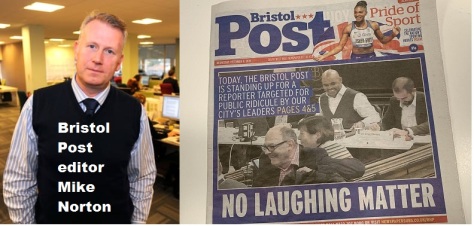
Was Easton-born Bristol Post editor Mike Norton sacked because he called out Bristol mayor Marvin Rees’ for bullying journalist Adam Postans?

Bristol Post editor slams mayor’s ‘petty and childish’ ridicule of local democracy reporter – ‘That the people who run our city would behave in this way towards another human being, in plain sight, is reprehensible. It is an abuse of the public platform which their roles bestow upon them. And that’s the point here. Adam is not just a journalist. He represents the public, who pay his wages – and the wages of the people mocking him. When Mr Rees and his cronies ridiculed Adam, they were ridiculing all of us and our right to scrutinise council business. Adam, who has been a qualified journalist for 24 years, was the only reporter at the meeting. These people would clearly prefer his seat to remain unoccupied. They want to control the narrative of how the council’s business is reported, laced with their own nuances and no mentions of overspends or attribution.

Reach PLC controls Express, Mirror and Bristol Post, editor for 15 years Mike Norton has ‘left’ The Post – Bristol Post newspaper job cuts ‘a threat to democracy’ – The National Union of Journalists has warned about the “threat to democracy” over the planned cuts. Redundancies at two local newspapers pose “a grave threat” to Bristol’s democracy, a union has warned. All nine news reporters at the Bristol Post are at risk along with all staff at the Western Daily Press. “Fewer journalists means fewer people to question those in power,” a spokesperson for the National Union of Journalists said. The owner of the two titles, Reach, said it was “proud” of its Bristol papers and the “vital role” they play. “Reach continues to consult with colleagues and trade unions over the proposed changes which are subject to a minimum-45 day statutory consultation period,” the statement added. “The pandemic has seen significant declines in local advertising, so these changes are required and are about us operating more efficiently to protect local journalism and our news brands for the long-term.” Reach, which was created in March 2018 when Trinity Mirror bought the Daily Express and other titles, saw a 13% drop in revenue last year amid a continued decline in print newspaper sales. ‘Grave threat’: The firm, which also runs the Bristol Live website, announced the cuts earlier in July. In a meeting with staff on Wednesday, bosses told employees that 22 of 58 at-risk posts would be going across titles in the South West. Nationally, Reach is cutting 550 jobs. It comes after the editor of the Post, Mike Norton, left his job after 15 years in the role. 

Unrelated article ->

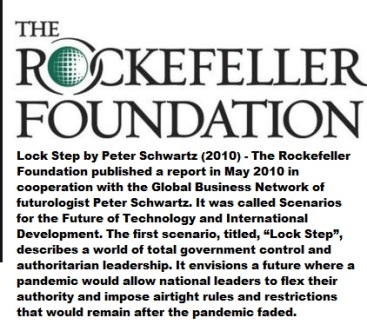
Rockefeller Foundation ‘Lock Step’ Paper Published in 2010 Predicted How a Pandemic Could be Used as an Excuse to Establish Global Authoritarian Power – Need to Know’ news site – Lockstep. China. Depopulation and Covid 19 – The report in question has the bland title, “Scenarios for the Future of Technology and International Development.” It was published in May 2010 in cooperation with the Global Business Network of futurologist Peter Schwartz

Forgive us our trespasses: forbidden rambles with right-to-roam campaigner Nick Hayes [Observer article]

 
Forgive us our trespasses: forbidden rambles with a right-to-roam campaigner

The law excludes ordinary people from 92% of English land, but that doesn’t stop activist, artist and writer Nick Hayes

by Rachel Cooke, The Observer, 9/8/2020
Ref: https://www.theguardian.com/uk-news/2020/aug/09/forgive-us-our-trespasses-forbidden-rambles-with-a-right-to-roam-campaigner

As Simon Jenkins notes in his book England’s Thousand Best Houses, were it not for the fact that it sits in 400 acres of historic parkland, Basildon Park house in west Berkshire might almost be a Piccadilly terrace: big, but not gargantuan; elegant and harmonious, but too straightforward to be entirely flashy. Glimpsed through trees on a warm summer evening, its magnificent portico crested by golden sunlight, it rises like a beacon, a sight from which it’s hard to tear the eyes. Even when I’m walking away from it, I keep turning my head to check that I didn’t only imagine it; that it hasn’t suddenly vanished into thin air.

But bewitchment is in the air tonight. This place is ours. Though the National Trust reopened these grounds to visitors in June, those who booked tickets for today are long gone now, it being past five o’clock. Circumnavigating the estate’s flinty, tumbledown perimeter wall, we barely saw a soul – only one mountain biker, doggedly following the same bridleway as us – and since we slipped inside the park itself, having finally found a gap just wide enough to allow us to do so, we’ve encountered no one at all. We stride, willy nilly, utterly free, grasshoppers leaping at our feet, the soft wind in the branches above us. What leafy seclusion. It’s so enveloping, and so soothing, I jump halfway out of my skin when a pheasant shrieks in the undergrowth.

There are bylaws around respecting National Trust land but I do not feel deep down that I’m doing much wrong by being here. What harm is there in enjoying such loveliness? I’m a paid up member of the Trust, so this is no embezzlement. Nevertheless, I don’t suppose I would have wriggled through that tempting space had I been alone. I see walls, literal and metaphorical, and often wonder what’s to be found behind them, but I’m too timid, often, to climb them. On this occasion, however, I have courage in the form of company. I’ve been led astray by Nick Hayes, the author of The Book of Trespass, a powerful new narrative about the vexed issue of land rights and a volume that he hopes will both refocus the ongoing campaign to reform the 2000 Countryside and Rights of Way Act by encouraging more people to do as we are doing right now, to walk on privately owned land, and to help build protest against the Conservative party’s plan – a manifesto commitment – to make trespass a criminal offence. Not only is Hayes practically a professional trespasser these days, no sign too forbidding to be ignored, no fence too high to be climbed. In my case, he’s like a naughty younger brother, egging me on, urging me blithely to step over whatever impediment happens to be in my way. “They can’t do anything to us,” he says, cheerfully. “They can ask us to leave, but we can’t be prosecuted. Trespass is a mechanism for seeking redress for damage, and it would be absurd to suggest we are damaging anything.” (Trespass can be actionable through the courts, whether or not the claimant has suffered damage – but such cases are rare, and usually only brought to deter persistent trespassing, or where there are boundary disputes.)

This is the part of Berkshire, not far from the River Thames in Pangbourne, that inspired Kenneth Grahame to write The Wind in the Willows, and Hayes, who likes to kayak, knows it intimately. He grew up a few minutes away, in the village of Upper Basildon, and it was there, 10 years ago, that the seeds of his book were sown, when he came home from London to live with his parents while he worked on his first graphic novel (he makes his living mainly as an illustrator). One day, he and his mother were walking together after lunch. They were, he says, having the kind of heart-to-heart that could only really happen in “the easy chaos of the countryside”, wandering towards a spot that, at the time, was the sole place he’d ever seen a kingfisher. But they never made it. Suddenly, a quad bike came chugging over the paddock, and parked itself, just a little too close for comfort, in their way.

The gambit of the landowner or his agent to the trespasser is often a facetious “are you lost?” But this guy was more direct. “You’ve no right to be here,” he said. “You are trespassing.” Hayes and his mother reflexively apologised and promptly left. Only later did he consider the astonishing effect just a few words had had on them; it was as if they were two puppets, and this stranger had simply yanked their strings. “We were doing such a lovely thing,” he says. “So to be interrupted in such a gruff manner… This invisible force came over us. Outwardly, it was just decency [on our part]. It would have been indecent for us to argue; that would have spoilt our day. But his ability to turn us on our heels through 180 degrees felt like power to me, and it’s quite rare for a white, straight, middle-class man [like me] to feel the operation of power like that. There was this feeling of shame – as though I’d done something wrong. And that didn’t square at all with my inner morality.”

After this, Hayes began strolling on private land more and more often. This wasn’t, he insists, a political act, or even just a two-fingers to those types who like to border the land they own with signs that read “Keep out”. “It was more a case of wanting to support my feeling intellectually that it’s the wall that is the crime, not the climbing of it,” he says. “I wasn’t going to stop trespassing, but I also came to realise that it’s all right for me. This is something I can do. I’ve got quite a posh voice, I’m white, I’m a big enough dude not to be physically submissive; I don’t flinch when someone comes at me. The book grew not only out of my own trespassing, but out of a desire to try and make the countryside more available to people without my privileges.” England, he would go on to discover, is still owned by a relatively small number of wealthy individuals and institutions: by the law of trespass, we are excluded from 92% of the land and 97% of its waterways. How can this be? The feeling grew in him that change must and can come. When The Book of Trespass is published later this month, he and Guy Shrubsole, the activist author of Who Owns England? (which came out last year), will together launch a new campaign, the primary focus of which will be the fact that the nation’s mental and physical health would be improved immeasurably by increased access to it. “I don’t believe property is theft,” Hayes says. “That’s a ridiculous proposition, one that ignores human nature. This isn’t the politics of envy. All we’re asking is that the lines between us and the land are made more permeable.”

This doesn’t mean, however, that political history is of no interest to him. Quite the contrary. For Hayes, Basildon Park house serves as one symbol among many of the way, down the centuries, land was effectively stolen from the people, its grand estates constructed on the back of their exploitation. Built in 1776 by John Carr of York, it was designed for Francis Sykes, a wealthy member of the East India Company, who returned home with fingers that were, as Hayes puts it, “sticky from the colonial cookie jar” (Sykes himself explained the bleeding dry of India as a basic choice of “whether it [the wealth extracted under British rule] should go into a black man’s pocket or my own”).. Hayes doesn’t disapprove of the National Trust; he’s largely supportive of both it and English Heritage. But he wonders why, given the history of Basildon Park, some of its 400 acres could not be given over to, say, local allotment holders. And what about those who cannot afford its ticket prices? “I think the vision of Octavia Hill [the social reformer, and one of the three founders of the National Trust] for the working classes has gone a bit wayward. It does seem very white and middle class. It holds some of our cultural soul, and it could change the narrative if it tried.”

We walk on. The preternatural quietness holds. The atmosphere is almost muffled. The cows, it seems, can’t be bothered to low at this hour, in this heat. But just as we’re on our way back to our entry point, we meet a woman on the path. She has long, silver hair and a black spaniel, and a manner that, though polite, expresses a certain dismay at our presence. Do we work for the National Trust? No. Then why are we here? We tell her that we’re merely enjoying the park, and then we turn the tables, asking her a few questions of our own – which is how we find out that she is the wife of a National Trust warden, and that she lives in a house in the woods. Also, that she is Dutch. Do people have the right to roam in Holland? No, she says. It’s worse there than here.

But she won’t be put off so easily. We should go. Soon, this spot will be dangerous for us. In half an hour, hunters are coming to shoot deer, which must be controlled. “Well, they’re not going to shoot us, are they?” says Hayes, breaking into laughter. She doesn’t fully smile at this – though whether this is because we outnumber her and she feels vaguely intimidated, or whether because she simply believes we’re being foolhardy, I can’t quite tell. Either way, though, I’m momentarily chastened: I experience what Hayes calls, in his book, a “mind wall” – an invisible barrier rises, over which I feel I must now hop as quickly as possible to the side where I rightfully belong.

My fellow trespasser and I do most of our talking in a hay field belonging to someone known to him as Farmer Ambler, a man who eventually appears, carrying long stems of ragwort (ragwort is toxic if eaten by cows), but who speaks to us gently, and doesn’t tell us to scram.

Hayes wasn’t what you might call a child of nature. “We came up to the rec to smoke hash as teenagers,” he says. “Sometimes, a couple of woods on from where we’re sitting now, we made fires and messed around. But we weren’t there for nature; it was just free space.” After public school and Cambridge University, he did an art foundation course and eventually, after a series of jobs working in communications for charities, he began working full time on his first graphic novel, The Rime of the Modern Mariner, a take on Coleridge’s famous poem. He has since published three more.

The Book of Trespass is his first non-graphic book – though the text is punctuated by his marvellous illustrations, linocuts that bring to mind the Erics, Gill and Ravilious – and in it, he weaves several centuries of English history together with the stories of gypsies, witches, ramblers, migrants and campaigners, as well as his own adventures. Its sweep is vast. Among the places he trespasses, sometimes camping out overnight, are Highclere Castle in Hampshire, home of the Earl of Carnarvon and now best known as the real Downton Abbey; Belvoir Castle in Leicestershire, the seat of the dukes of Rutland; on the Sussex estate of Paul Dacre, the former editor of the Daily Mail; and on land, also in Sussex, owned by the property tycoon Nicholas van Hoogstraten. He also kayaks on the River Kennet from Aldermaston, in west Berkshire, to the point near Reading where it meets the Thames – a journey that takes him through the estate owned by Richard Benyon who, until 2019, was the richest MP in Parliament (Benyon lives in Englefield House, which dates from 1558, and which passed to his family by marriage in the 18th century; some of their money was made via the East India Company, too).

His book begins with the mass trespass of Kinder Scout in 1932, an act of civil disobedience that may be one of the most successful in British history (it led to the creation of our national parks). But then he tracks back: here is William the Conqueror, seizing England with “both his hands”; here are the Tudor barons, frantically enclosing common land in what amounted to a kind of rural gold rush; and here, much later, is the Public Order Act of 1994, a piece of legislation, triggered by a rave at Castlemorton Common in Worcestershire, that Hayes regards as “the final nail in the coffin” for freedom in the countryside, and that has a great deal in common with vagrancy acts of earlier centuries in the way that it targets particular groups of people, notably Travellers. Along the way, he also explores more nebulous territory. Why, he wonders, do we quietly accept the limits to our freedom – the signs and the barbed wire, the CCTV cameras and the walls – when we’re out and about? Where does such obedience come from? Nationalism, he believes, suits the landowning classes – Paul Dacre, who also owns a 17,000 acre grouse farm near Ullapool in Scotland, now among them – because it gives people a sense of ownership without their actually owning anything at all.


Source: The Guardian (The article is reproduced in full here)

Our green and pleasant land. Except it isn’t – ours, I mean. A third of Britain is still owned by the aristocracy; 24 non-royal dukes alone own almost 4m acres of it (in 2016, 17 of these men together received farm subsidies worth £8.4m). Then there is the new aristocracy, the self-made millionaires who can afford to buy up the land: men like Richard Bannister, the retail tycoon who bought Walshaw Moor in Calderdale in 2002, and whose “management” of this rare habitat brought him into conflict with Natural England – until, that is, the agency dropped its claim, settling out of court (Bannister now owns some 16,000 acres of the valley). Finally, there are the offshore companies, which in 2015 owned 490,000 acres of England and Wales, meaning that an area larger than Greater London can legally avoid stamp duty and inheritance tax (the largest swathe of English land registered to offshore companies is the Gunnerside estate, whose 27,258 acres of North Yorkshire moorland are registered in the British Virgin Islands and which, over the last decade or so, received some €430,000 of taxpayer handouts in the form of agricultural subsidies). According to Hayes, there are “good landowners”: he would single out the Crown Estate and Sir Julian Rose, the owner of Hardwick House, also in Berkshire, whose farm is run on ecological principles and who allows a nonprofit group to run outdoor activities for children with disabilities on his land. But these people are, in his view, in the minority.

Was he, as he researched The Book of Trespass, surprised by the numbers? “No. In a way, I was almost encouraged by them. They’re so stark, they do the arguing for you. The orthodoxy is that land campaigners are very unreasonable – that they’re people who want to overturn civil society, who have this mad communist desire to overrule people’s private sanctity. But if you look at the figures, it’s clear that it’s not at all unreasonable for us to require greater access to the land.” He’s surely right about this – and in Scotland, people already have the right to roam; none of the walks in his book would count as trespass north of the border. But it also raises the question: why does it still matter so much to landowners if people cross their land? Why does it make some of them so furious?

“Because, under a certain philosophy of property, one we’ve had since the time of William the Conqueror, something is only yours if you own it exclusively; a park doesn’t really belong to you if you can’t throw someone out of it. Counter to this, of course, there is another philosophy, one that says that you don’t leave this world with anything in your pockets, and you don’t come into it with anything in them, either. At best, you borrow the land from your children; you’re a custodian. Unfortunately, these are entirely opposing definitions of property.” Chewing idly on some grass, I wonder aloud why some people need so much. Hayes looks at me as though I’m slightly stupid. “It’s not about use,” he says. “The rich man wants more. You know that.”

There are, he tells me, groups out there who are interested in the idea of reparation; who believe that if more people knew the stories behind places like Basildon Park, they would be more exercised over the issue of land rights. But he would rather concentrate, in campaigning terms, on the future rather than the past. “If I had two minutes on the Today programme, I would talk about the science involved in the relationship between nature and mental and physical wellbeing, and about a future where landowners aren’t robbed of anything at all, except the right to exclude the mass public. Douglas Caffyn [a canoe campaigner] speaks about the Magna Carta when he makes the case for access to our rivers. But we can either argue about historical precedent, or we can clear the table of that, and discuss why, say, rivers are so essential to people.”

He is not – again, he tells me – looking for a revolution. “The one thing I think is a genuine and valid concern [on the part of landowners] is vandalism and litter. But this is why we need an early and visceral relationship with nature. Children need to learn about dragonflies by having them land on their noses so that as adults they will find it abhorrent to see a Wispa Gold wrapper next to an orchid.” He and his fellow campaigners are looking to “rewrite” the Countryside Code. “It asks too little,” he says. “It shouldn’t only tell you to take your litter home; it should tell you to pick up any litter that you find. We would like it to be more moral, to incorporate how we should be together – because the way we treat nature is the way that we treat each other.”

So what happens next? “We want to engage all the people who are already sold on access – the fathers and mothers, the ramblers, climbers and kayakers – and tell them that something is happening, and get them to join us. Then we need to persuade all the people who don’t have much access to land why their lives would be improved if they did. And then, we need to lobby MPs.” His book, he believes, is the beginning of something, not the end. “We will say to people: come trespassing with us!” He grins. “Our hashtag will be #extremelynonviolentdirectaction. There’ll be animal masks and botany, picnics and poetry. But if someone asks us to leave, that’s exactly what we’ll do.”

See righttoroam.org.uk

The National Trust bylaws can be seen here: https://nt.global.ssl.fastly.net/documents/the-national-trust-byelaws-1965.pdf

• The Book of Trespass by Nick Hayes is published by Bloomsbury (£20). To order a copy for £17.40 go to guardianbookshop.com. Postage charges may apply.

TLIO and the Tories’ Campaign against the Planning System

(From The Land magazine, Spring 2007 )

Over the past few years, neo-liberal think tanks and right wing commentators have been mounting an assault on the planning system superficially similar to the critique advanced by Chapter 7 and The Land Is Ours. It is time that we made clear the difference. The following is a TLIO draft policy statement which is open to consultation.  TLIO agrees with right wing critics that the planning system currently causes artificially high housing prices;  but TLIO should distance itself from the view that the countryside can absorb suburban development without damage; and from proposals to abandon or run down agricultural production in the UK and rely on imported food. The planning system is the main way in which landless people can exert social control over the activities of landowners, and it should be reformed to promote affordability and sustainability, rather than weakened or abolished.

What would happen to the Countryside without planning controls? A typical response might be that the whole of the South East would be covered in bungalows with quarter-acre plots and the countryside as we know it would vanish . . .But would an end to planning controls mean that every green space was covered in concrete? I think not. Currently in England, less than 12 per cent of our land is covered in bricks and mortar
. . . The cost of housing would fall. Land-use planning protects vested interests to the detriment of the UK as a whole.”
Linda Whetstone

The above quote comes from an article called “Land-Use Planning — A Penalty on the Poor”. It sounds very egalitarian, but in fact Linda Whetstone is a dressage judge and a board member of three right wing think tanks, including the Institute of Economic Affairs (IEA). Her late father was Anthony Fisher “one of the most influential background players in the global rise of libertarian think-tanks,” including the IEA, the Adam Smith Institute and the Manhattan Project Her brother Mike Fisher, is also a trustee of the IEA and her husband is a Tory councillor. It is easier to see where she is coming from when we include a further observation she makes about covering the south east in bungalows:
“Why not replace planning with resource allocation via the market, which is the system that has increasingly been used in so many other spheres, and with such obvious benefit? If this produced the predicted number of bungalows, then how could you argue that it is not as optimal an allocation of land as is possible?”

Unfortunately (or not, depending upon your viewpoint) quarter-acre plots with bungalows are perhaps not what would occur across much of the South East if we got rid of the planning system. Letting the market decide means letting people with money decide, and people with plenty of money don’t want to live surrounded by bungalows. In the absence of planning  controls, the wealthy would buy up large tracts of land to ensure that their dreamhouse was in a place where bungalows, pig farms, travellers camps, hippy shacks and the like could not pop up out of nowhere. The value of land would depend upon how much seclusion it offered in relation to its proximity to London or another metropolitan centre: plum sites in greenbelts would go for phenomenal sums of money. Further out, thousand-acre estates would be gated, landscaped and given over to a handful of “country houses” for multi-millionaires. Elsewhere, plot size might aspire towards the 1-2 acres typical of wealthy out-of town US suburbs; Large areas of the South East, and much of the rest of Britain, would become a stockbrokers’ Arcadia, utterly dependent on cars and devoid of public transport. Sales of ride-on lawnmowers would rocket, and farmworkers would be replaced by cap-doffing gardeners and ostlers. Whetstone’s agenda is not so much egalitarian as populist, and like many forms of populism, is, in practice, regressive.

The Anti-Planning Pack
Whetstone’s right wing credentials are shared by quite a few
of the voices calling for the rolling back of the 1947 Town and
Country Planning Act. In 1996 Mark Pennington who is on the
board of four right wing think tanks, produced a paper for the
IEA, which evolved into his 2001 book Liberating the Land — a
call for planning restrictions to be replaced by “market solutions” such as restrictive covenants. When it was published, Matt
Ridley, the climate-change-denying journalist, who sits with Pennington on the advisory board of the UK think tank Reform,
gave it a full feature review in the Telegraph under the by-line
“Planning Rules Ruin the Environment and Reward Developers
at the Expense of the Poor”.
In 2006, The Adam Smith Institute published a report by
Mischa Balen which, citing yet another IEA report on The Rural
Economy, argued “there is a strong case for the planning process
to be abolished, and the useful functions it performs replaced
by an increased reliance on Restrictive Covenants and Nuisance
Law”. Balen also proposed a less drastic “lowland crofting” style
scheme, to convert three per cent of English and Welsh farms
to woodland and housing estates (the houses crammed into
clearings at an extraordinary density of 70 to the hectare).
Another strand of the flourishing anti-planning front, driven less by ideology than by a desire to unleash the forces of development, has roots in a famous article published in New Society by Peter Hall and three colleagues in 1969. “Non-Plan: An Experiment in Freedom” advocated a mobile car-dependent suburbia centred around neon-lit Las Vegas style edge-of-town strips, which they claimed, “represent the living architecture of our age.” Two of the four authors of “NonPlan” were architects, and it is perhaps no coincidence that a similar approach (albeit less infatuated with neon) is articulated today by the architects associated with audacity.org — people like Martin Pawley, Ian Abley and James Woudhuysen.   Audacity’s latest publication, Let’s Build: Why We Need Five Million New Homes in the Next 10 Years, by
James Heartfield, which relaunches many of the same arguments for the abandonment of the planning system, is sponsored by a building industry body called the Modern Masonry Alliance.

Along with these two main strands there
are a number of fellow travellers, of indeterminate ideological
persuasion, for example Essex University professor Jules Lubbock. Another maverick is Kevin Cahill, author of the recently
published Who Owns the World. Cahill’s work is heavily larded
with Fenian republicanism, but his hypothesis is based on the
theories of Peruvian economist Hernando de Soto, winner of
the Cato Institute’s Milton Friedman Prize. Cahill is more directly concerned with land tenure issues than planning, but his views
on the redundancy of European agriculture and the availability
of land chime with those of the think tanks (see review p. 12).
This debate is taking place in a climate where certain forces
in the Labour government are pushing for a relaxation of planning constraints. The Barker Review of Planning cites the Adam
Smith Institute report, and flags up neo-liberal approaches towards land-use planning, even if it only nudges the planning
system a little way in this direction (see comment p.6).

These right wing critics hold the green movement responsible for much of the pressure which keeps an unjust planning system buoyant, and not without reason. The Campaign
to Protect Rural England helped steer through the 1947 Town
and Country Planning Act, and Friends of the Earth is vocal in
supporting its maintenance. Heartfield also blames a “GrungeNimby axis”, emerging out of the road protests of the 1990s.
Whilst he is correct in identifying an alliance between Grunge
and Nimby in respect of roads, this alliance tends to fall apart
when it comes to the planning system, for one obvious reason:
Nimbys are rich and live in posh houses, while Grungies are
poor and live in benders and caravans which tend to be subject
to enforcement notices..

The environmental movement is less homogenous than its
critics like to believe. For the last ten years The Land Is Ours
and Chapter 7 have been criticizing the perversity and inequity
of the planning system, with support from the Permaculture
movement, and some elements of the organic farming and sustainable forestry sectors. Certain aspects of Chapter 7’s critique of the planning system are similar to that of the think tanks — we agree with Matt Ridley that “planning rules reward developers at the expense of the poor” — with the result that the
head of one top university planning department remarked that
he thought that Chapter 7 had right wing tendencies.
It is therefore a matter of some importance for us to set out
as clearly as possible where TLIO’s and Chapter 7’s critique of
the planning system diverges from the right-wing critique.
A Shortage of Land?

To do so let us take a sentence from Heartfield’s book — though similar sentiments are expressed in most of the works cited above:
“The reason that the argument over building houses has turned so bad-tempered is not because of an absolute shortage of land, but because the government has set out to restrict the land available for development.”

The second half of this sentence is one on which TLIO
and the right wing agree. The planning system restricts supply,
but does not restrict demand (three quarters of the demand for
extra housing comes from people choosing to live on their own);
people are free to buy houses, but not free to build them. The
inevitable results are scarcity, rising prices, homelessness and
speculation.

It is in the first half of the statement — that there is no
“absolute shortage of land” — that disagreement lies. The antiplanning pack maintain that there is plenty of land available
which is not required for some other use. This a contentious
statement, to say the least, not borne out either by rising land
prices, which suggest that land is highly sought after, or by public disputes about developments, which suggest that the use of
land is highly contested. What the right-wing actually means is
that there is plenty of land around which they would like to
see developed, whatever anybody else might think; and if planning controls were abolished and the market took over, this land
would be developed for housing and commerce because these
are more lucrative than alternative uses.

There are two major land uses which the right wing deliberately undervalues — open space and agriculture. The two often
go hand in hand, but here we examine separately how they are
treated by the neo-liberal anti-planners.

Open Space
Virtually all right wing commentators observe, at some
point in their argument, that “urban areas account for no more
than 10 per cent of the entire country” or “less than 12 per cent
of our land is covered in bricks and mortar and concrete.” The
Barker review cites figures of between 9.8 and 13.2. There is no
danger, they tell of us, of England being “concreted over” or
“paved” . Ninety per cent of the country is undeveloped and
so “if as many a 10 million houses new houses, all with decent
gardens were to be built . . . only a little more than 2 per cent of
the land would be concreted over.”

This endlessly repeated argument is childish since none of
their opponents is claiming that 100 per cent, or anything near
that amount of the countryside, is at risk of being physically
“concreted over”. Objections to untrammelled development are
based on the entirely reasonable observation that any dwelling
has an impact well beyond its physical footprint, in terms of
traffic, roads, pylons, lighting, noise, infrastructure, sewage services, quarrying, wildlife impact, visual impact, need for facilities
and services, and so on. The radius of urban and suburban contamination stretches a good deal further than the circumference
of the urban settlement. Note how the right wing clamours for
the development of the green-belt on the grounds that it is degraded, whilst at the same time including it within the 88 per
cent of land that they claim is untouched by development.
Moreover a quantitative change in the amount of housing leads to a qualitative change in the community. Many natives of the south east have moved north or west, because the village where they were raised has ceased to be a village and become a suburb. Their flight
is an expression of the demand for rural land. So too is the 6 figure premium that wealthy people pay for an isolated house in the countryside. What else are these people paying for if not open space?
This is not some illusory demand invented by CPRE and it can’t be made to go away simply by abolishing planning.
As we suggested at the beginning, in a free market where open space was unsecured by the planning system, those who could afford to buy privacy and exclusion would pay as much to secure it as they do now — probably more.

In other words, the seclusion, the tranquillity and the rurality are a public good, insofar as they are controlled and preserved by the planning system. Those who want to abolish the planning system want to see this seclusion, tranquillity and ruralness privatized
and sold off to the highest bidder. The current planning system
serves the interests of an élite who can afford to buy a scarce
house in a countryside where development is constrained. Abolish those constraints, and the élite will be securing exclusive
space in an environment where development is rampant. Houses will become cheaper, but open space, that is to say agricultural
land, will become more expensive. For the commoner there is
nothing to gain from a leap out of the regulated frying pan into
the unregulated fire.

Agriculture
The other main reason why people value land is for its productive use — growing, rearing or extracting a product for sale,
for subsistence use, or just for fun. Once again this requirement
for land is glibly dismissed by most of these right-wingers (the
notable exception being the dressage lady). There is “ a tremendous superfluity of agricultural produce which has left a huge
surplus of agricultural land,” say the Audacity crew. Lubbock
talks of ”land no longer needed for agricultural production on
the post-war scale.”

This is the impression of the countryside given by newspapers turned out in Wapping and members of London’s chattering classes generally. The trouble is that it is not true. Where is
this huge surplus of land? If it is so useless and unwanted, why
aren’t the bastards sitting on thousands of acres of it selling it
off? Why is agricultural land fetching such high prices — up to
£10,000 per acre for woodland, and £20,000 for pasture when
sold in small acreages?

Clearly none of these right-wingers, (again with the probable exception of the dressage lady) have been to a land auction here in the West Country recently, where they would see surviving dairy farmers anxious to expand their business, young locals seeking a foothold for their stock, horsey people looking for grazing , rich urban refugees after a hobby farm, house-owners securing their
own private green belt, hippies and organic smallholders, community woodland planters and animal sanctuary managers all
prepared to bid above the guide price for a precious few plots of land — whether or not they benefit from entitlements to
Single Farm Payments.. The urban pundits have obviously not read the recent report from estate agents Strutt and Parker, which
states that arable land prices have risen yet again over the last year, grassland has gone up even faster, and “both farmers and lifestyle buyers are having to contend with a continual shortage of land for sale” . Nor can they have seen Savills’ latest advertisement in the farming press which trumpets:
“The 2006 farmland market: STRONG DEMAND + SHORTAGE OF SUPPLY = INCREASED LAND VALUES.”

Stags’ viewing figures have nearly doubled in two years, while the volume of sales has halved over the last decade. We could go on
piling on the evidence that rural land market is in great demand,
but is there any point because this is obviously not what townies
want to hear?

The “surplus of agricultural land” is not a phenomenon
that any of these neo-liberals have actually observed, but rather
an expression of what they would wish to see, and hope that the
WTO trade rules will bring about, by the production of food in
foreign countries so that we in Britain can devote our land to
the more lucrative business of building houses.

This is Mischa Balen:
“Rather than continuing to produce food for ourselves, we should be  prepared to buy foodstuffs from other countries. We would benefit from lower food prices as a result of lower labour costs in these nations, and they would benefit from receiving money in return for their produce.”
Kevin Cahill agrees:
“As cheap Eastern food production replaces expensive Western production, the vast acreage of already redundant Western agricultural land . . . will have to be allocated to housing, complete with gardens.”
The belief of neo-liberals in the sanctity of the market is so
complete that, 200 years after the abolition of slavery, they find
nothing morally repugnant about paying people in Third World
countries slave wages to uproot their forests and exhaust their
soils in order to produce food and commodities for people who
swan around on thoroughbreds and dig swimming pools on
grade 1 agricultural land. The only conceivable justification, as
Balen remarks, is that people in poor countries “would benefit
from receiving money in return for their produce.” Up till now,
the export of agricultural commodities has conspicuously failed
to improve the lot of most Third World peasants. But if ever
they are allowed to become as rich as we are, and eat as much
meat as we do, then their produce will no longer be cheap, and
we in Britain will need our farmland to grow our own food.
Besides, there is no evidence that this neo-imperialist abdication from home food production has resulted in any drop
in the use of agricultural land at home — much as all the vultures waiting to develop it would like there to be. Look at the
DEFRA graph reproduced in Let’s Build, showing the decline in
agricultural land over a period when UK food self-sufficiency
dropped by about 10 per cent. Pictorially, it looks as though the
agricultural area has dropped by nearly half, but this is a deceit.
The left hand column shows that in fact the agricultural area has
declined from 19 million hectares in 1987, to 18,650,000 ha in
2003 — a drop of 1.84 per cent in 16 years, during which agriculture underwent the worst crisis it had seen for over 60 years.
The slight slack is no doubt more than taken up by the rise in organic agriculture, horseyculture, woodland planting, nature conservation, animal sanctuaries and a host of other activities. As
Joan Thirsk’s book Alternative Agriculture shows, “farmers have
worked over this ground at least three times before in our documented history”: every time there is an agricultural crisis new
crops appear, and new entrants replace farmers who drop out.
A graph showing agricultural land values over the same
period would show a considerable rise in demand for land. No doubt the price is partly held up by European subsidies and setaside. But if EU and North American subsidies for grain were
removed, the world price for grain would rise, so there would
not necessarily be that great a drop in agricultural production in
the UK, unless we accepted imported UHV milk. Arable land
in the East of England supports higher yields of wheat than
virtually anywhere in the world, so it is unlikely that it would be
abandoned.
On top of that, with a move away from fossil fuels in order
to address climate change, any spare arable or set-aside land is
likely to be required for renewable energy crops — which are
very extravagant on land. In 20 or 30 years time, we may need to
make use of every scrap of agricultural land we can find — do
we really want to encourage wealthy homeowners to buy it up to
secure their own private green belt?

TLIO’s Position
In summary, the right-wing assault on the planning system
propagates the fib that rural land is unwanted, and uncontested, in order to justify the buy-out of farmland by developers.
Countless farmhouses, farm buildings and rural workers’ cottages have already been sold off for market housing; but not
content with that, the developers now want to subdivide farmland, no doubt in the most charming parts of the countryside,
to provide homes and gardens for people with inflated urban
incomes who have no particular reason to be there, other than
to enjoy the open space which is claimed to be in such abundant supply. This programme would create a vast and pointless
suburbia. It would erode the public’s access to open space; and
diminish working people’s access to productive agricultural land.
It would undermine a land resource which in years to come we
may very well have to rely on. And it is being advanced duplicitously as a way of eliminating a “penalty on the poor” when in
fact it introduces further licence for the rich.

This is an agenda which TLIO and Chapter 7 should unambiguously reject. The planning system is now the main means
the public have of limiting what would otherwise be the absolute
right of landowners to do whatever they pleased on their land,
at the expense of society as a whole. In a sense it has replaced
the customary and usufructory rights which, before enclosure,
mitigated the property rights of owners of common land.
It is true that current planning policies act perversely, to
exclude poor people from access to resources, and to secure the
rural environment for an elite — just as the benefits of common
land were mostly enjoyed by wealthy landowners. But that does not mean that the abolition or undermining of the planning system would help underprivileged people, any more than enclosure
of the commons helped the landless. Weakening the planning system would simply leave landowners and developers free to do whatever they wanted with our country.
Instead, there are ways in which the planning system can be overhauled so that it is less regressive, and the main role of Chapter
7 has been to examine and propagate these options. They revolve around a shift in stringency from allocational to criteria-based policies — in other words development should be permitted in more places but only if subject to much stiffer control over environmental impacts, particularly those associated with the motor car.

Mechanisms that can be employed include Simplified Planning Zones, a new use class for low impact development;
greater locational options for car free developments, better public access to the rural exceptions site policy, an overhaul of the agricultural tie system etc.

We also call upon other environmental lobbies who value the planning system, such as the CPRE and Friends of the Earth, to
stop putting all their money into “compact cities” and stop burying their head in the sand. It is an undisputed fact that large numbers of people would prefer to live a more rural existence, and this is an understandable aspiration. The aim of environmental organizations should be to find ways of accommodating more people in thriving landbased rural economies, without degrading the environment or undermining the public good. Frustrating people’s desires and shoring up the privileges of an élite, by cramming the people against their will into cities, undermines the credibility of the very planning
system which CPRE and FoE ought to be supporting, and plays into the hands of right wing advocates of profligate, car dependent,
suburbia.

SOURCES